
Emergency Department revenue cycle services for registration accuracy, compliant coding, and faster emergency cash.

Revenue cycle performance in the emergency department depends on rapid registration, coverage discovery, demographic accuracy, medical necessity support, facility E/M coding, professional coding coordination, charge capture, observation and ancillary linkage, claim edits, denial prevention, payment posting, and A/R follow-up. Our operating model helps revenue cycle leaders reduce defects created by unscheduled high-volume encounters before they become payer friction, patient balance issues, or preventable write-offs.
7 of top 20
U.S. health systems served
32M+
Coding charts processed annually
28M+
A/R claims managed annually
Emergency revenue cycles need fast accuracy in a setting built for unscheduled care.
The emergency department creates revenue cycle pressure because access, documentation, coding, charging, billing, denials, and A/R must work around urgent, unscheduled, and often incomplete information. Leakage can enter through patient identity gaps, missing coverage, inaccurate demographics, incomplete clinical documentation, facility level assignment issues, modifier errors, ancillary charge misses, observation status complexity, payer edits, medical necessity denials, and self-pay follow-up. We support provider organizations with practitioner-led operations, workflow intelligence, and governance that converts encounter-level discipline into measurable financial performance.
Improve account accuracy without slowing emergency access
Protect reimbursement across facility and professional handoffs
Reduce denials and aged balances tied to unscheduled care
Specialty-specific support across every emergency revenue cycle handoff.
Emergency department programs need revenue cycle services that understand quick registration, identity validation, eligibility gaps, insurance discovery, demographic QA, EMTALA-sensitive access workflows, clinical documentation specificity, facility E/M levels, professional coding, observation linkage, injections and infusions, ancillary charges, claim edits, medical necessity reviews, payer denials, self-pay screening, and high-volume A/R. We organize support by where risk enters the encounter so front-office, mid-office, and back-office revenue cycle support for emergency department providers stays connected from arrival through account resolution.
Front-office
Rapid access validation and coverage discovery - fewer identity, demographic, and payer defects after the visit.
Mid-office
Documentation, coding, and charge controls - cleaner emergency claims and lower compliance exposure.
Back-office
Claim, denial, payment, and balance resolution - faster cash with fewer repeated emergency-specific defects.
Cleaner accounts. Accurate emergency coding. Fewer preventable denials.
Resolve coverage and identity gaps after unscheduled arrival
Patient access management, eligibility and benefits verification, registration QA and demographic accuracy, insurance discovery and coverage discovery, and financial clearance and counseling - so emergency encounters move with cleaner identity, payer, demographic, and financial status data.
Convert emergency documentation and services into accurate reimbursement
Medical coding, coding audits and quality assurance, clinical documentation integrity (CDI), charge capture optimization, and revenue integrity and leakage prevention - so acuity, facility level, professional coding, ancillary services, and charges align before claim submission.
Prevent emergency denials before appeal volume expands
Claims editing and clean-claim validation, claim submission and clearinghouse support, and denials management and appeals - so eligibility, medical necessity, coding, modifier, observation, and payer-edit issues get corrected earlier.
Move high-volume balances with root-cause visibility
Payment posting and reconciliation plus accounts receivable follow-up - so payer delay, secondary billing, coordination of benefits, self-pay conversion, and aged inventory move with clear ownership.
One operating model. Three pillars. Every engagement.
Expertise-led
Specialists who understand emergency access, ED coding, charge capture, payer edits, and high-volume A/R - not task queues in isolation.
- Patient access, coverage discovery, coding, CDI, charge review, billing, denial, payment, and A/R practitioners who work from emergency-specific playbooks
- A named engagement lead who connects registration quality, coding accuracy, denial prevention, cash movement, and patient balance outcomes
- SME calibration across ED facility coding, professional billing handoffs, observation linkage, medical necessity, payer edits, and compliance expectations
Technology-powered
RevAmp intelligence that turns encounter and claim signals into earlier action - so leakage becomes visible before it repeats across shifts and locations.
- Rules-driven prioritization across coverage gaps, registration defects, coding holds, claim edits, charge issues, denials, and A/R inventory
- Dashboards that connect productivity, quality, payer trends, denial reasons, cash movement, self-pay status, and recurring defect sources
- Automation that reduces repeat manual touches while preserving practitioner judgment for complex encounters and payer rules
Operationally-governed
Accountability with cadence, evidence, and ownership - not static reporting after emergency balances age.
- KPI reviews tied to registration quality, eligibility yield, coding accuracy, charge capture, clean-claim rate, denial rate, self-pay conversion, and A/R aging
- Quality audits and corrective action loops that reduce repeat defects by site, shift, payer, acuity level, and workflow source
- Transparent operating reviews with visibility into queues, exceptions, escalations, ownership, and financial results
Our Vision
Open Accountability: Taking responsibility without taking control.
Emergency revenue cycle leaders should not have to choose between operational control and partner accountability. You keep control of systems, access standards, clinical workflows, compliance requirements, and performance priorities. We bring trained capacity, technology support, quality controls, and governance to improve metrics we agree to own across modular support, co-managed operations, or end-to-end partnership.

Registration accuracy
Cleaner identity, demographic, and payer data after unscheduled arrival
Coverage discovery yield
More billable coverage found before self-pay balances age
Coding accuracy
Facility level, diagnosis, procedure, and modifier quality strengthened
Denial rate and overturn yield
Preventable emergency payer defects reduced with stronger evidence
A/R > 90 days
Aged emergency inventory resolved faster
Why Us
What sets our emergency revenue cycle approach apart.
When emergency revenue cycle work runs as isolated queues, registration defects, missing coverage, incomplete documentation, coding variation, missed charges, claim edits, denials, self-pay friction, and aged balances spread before leaders see the source. Our first-pass performance model connects the work earlier so each defect gets corrected where it starts, not only where it appears financially.
Rework-Powered Cleanup Machine
Our First-Pass Performance
Front-end accuracy
Identity, coverage, demographic, and financial status defects surface after billing or after balances age.
Access, eligibility, registration QA, insurance discovery, and financial counseling tighten account data early.
Documentation and coding
Incomplete ED notes, acuity gaps, modifier issues, and missed ancillary services trigger edits and rebills.
CDI, coding, charge review, and revenue integrity checks align emergency documentation to claim requirements.
Denial management
Appeal teams absorb repeating denials from eligibility, medical necessity, coding, observation, and payer-edit defects.
Denial reasons feed back into access, documentation, coding, charging, claim edits, and payer rules.
Cash acceleration
A/R follow-up works old emergency balances without always showing why accounts stalled.
Prioritized queues move payer, secondary, and self-pay balances while recurring defect sources are closed.
Audit readiness
Evidence gets assembled after a payer questions emergency necessity, coding, services, or payment.
Registration, coverage, documentation, code, charge, claim, and appeal evidence stays organized from the start.
Revenue cycle thinking for leaders who need fewer surprises.
Explore Vee Healthtek perspectives on the forces reshaping revenue cycle performance, healthcare operations, technology adoption, and financial resilience.
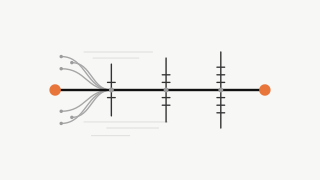
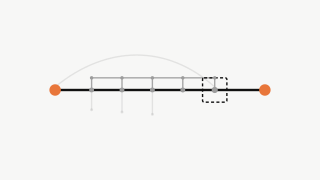

Find where emergency revenue leakage enters the encounter.
Schedule a 30-minute working session with an emergency revenue cycle lead. Bring one pressure point - registration quality, coverage discovery, facility level coding, observation linkage, ancillary charge capture, medical necessity denials, self-pay conversion, or aged A/R. We will map where the defect begins, how it affects reimbursement, and how a connected operating model can stabilize performance without taking control away from your team.
Continue exploring expert perspectives, industry trends, and practical strategies for improving revenue cycle performance.
Explore Points Of ViewFrequently Asked Questions
What makes emergency department revenue cycle management different from scheduled care?

Can you support only one part of our emergency revenue cycle?
Which Electronic Health Records (EHRs) and Electronic Medical Records (EMRs) do you support?
How do you reduce emergency denials without simply adding more appeals staff?
Do you provide offshore revenue cycle management for emergency department providers?
What KPIs should leaders track for emergency revenue cycle management services?
How does RevAmp fit into existing emergency revenue cycle systems?