

A healthcare provider’s guide to comparing revenue cycle management vendors
Seven criteria for selecting the right RCM partner.

April 20, 2026
Blog
7 minutes.

TL;DR
- Compare RCM vendors to domain depth, measurable outcomes, integrated workflows, delivery resilience, AI readiness and relationship governance.
- Look for a partner that prevents recurring defects, improves first-pass performance and makes ownership of results visible.
- Prioritize vendors whose capabilities align with your operating environment, performance gaps and financial goals.
- Use the provider list and seven-point framework to build a focused, defensible RCM vendor shortlist.
Comparing Revenue Cycle Management (RCM) vendors requires more than reviewing service lists, delivery locations or technology claims. Healthcare providers need to determine which RCM companies have the domain expertise, integrated workflows, measurable outcomes, delivery resilience and governance required for their specific operating environment.
This guide brings together a list of RCM service providers assessed by Everest Group and a practical seven-point evaluation framework. Healthcare CFOs and revenue cycle leaders can use it to compare RCM vendors, identify potential partners and build a shortlist based on organizational fit rather than market visibility alone.
What the RCM vendor assessment reveals about the market. | RCM Market Overview
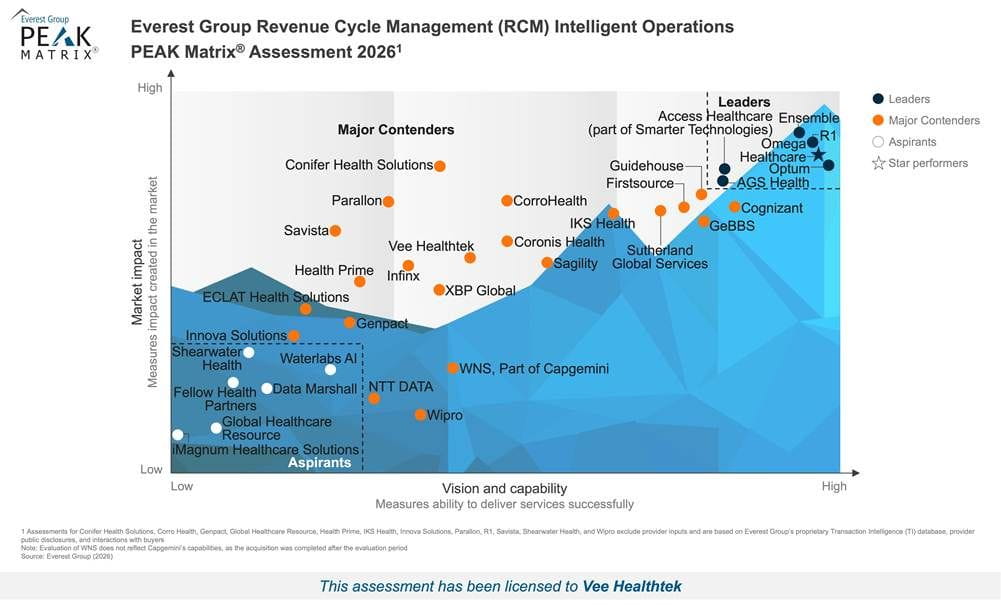
The Everest Group Revenue Cycle Management Intelligent Operations PEAK Matrix Assessment evaluates 34 service providers supporting U.S. healthcare providers. The broader market message is clear: RCM is moving beyond headcount-led outsourcing toward intelligent operating partnerships that combine healthcare expertise, process improvement, automation, analytics and AI.
Margin pressure, labor constraints, reimbursement complexity, fragmented workflows and growing patient financial responsibility are increasing the need for connected execution and measurable financial impact. Healthcare leaders can use the assessment as a starting point for discovering RCM companies before applying organization-specific criteria to build a shortlist.
Revenue cycle management companies to consider when building a shortlist. | RCM Companies Assessed
The assessment includes the following RCM service providers, grouped by their PEAK Matrix position. Healthcare organizations can use this list for initial market discovery before comparing vendors against their specific service, technology, operating and financial requirements.
- Leaders: Access Healthcare, part of Smarter Technologies; AGS Health; Ensemble; Omega Healthcare; Optum; and R1.
- Major Contenders: Cognizant; Conifer Health Solutions; Coronis Health; CorroHealth; ECLAT Health Solutions; Firstsource; GeBBS; Genpact; Guidehouse; Health Prime; IKS Health; Infinx; Innova Solutions; NTT DATA; Parallon; Sagility; Savista; Sutherland Global Services; Vee Healthtek; Wipro; WNS, part of Capgemini; and XBP Global.
- Aspirants: Data Marshall; Fellow Health Partners; Global Healthcare Resource; iMagnum Healthcare Solutions; Shearwater Health; and Waterlabs AI.
The market forces reshaping RCM partnerships. | Market Forces Reshaping RCM
Healthcare providers increasingly need partners that can work across disconnected EHR modules, clearinghouses and payer portals without creating more operational silos. Cybersecurity and AI governance also matter because revenue cycle workflows involve sensitive data and consequential financial decisions. The CMS Interoperability and Prior Authorization Final Rule offers context on information exchange and prior authorization, while the HHS healthcare cybersecurity performance goals provide healthcare-specific practices for cyber resilience.
These challenges are linked. A missed eligibility detail can become a delayed authorization, coding exception, rejected claim and avoidable A/R. Strong patient access management, eligibility and benefits verification and prior authorization help prevent defects early. Clinical documentation integrity, medical coding and revenue integrity help convert care into accurate, supportable claims.
Seven criteria for comparing RCM vendors and building a shortlist. | Seven Criteria For Comparison
- Confirm strategic fit and domain depth. Verify experience across your provider type, specialties, payer mix and priority revenue cycle functions. The proposed model should address your organization’s specific performance gaps rather than force them into a standard service scope.
- Test end-to-end workflow integration. Assess how patient access, documentation, coding, claims, denials and A/R connect across the vendor’s operating model and your existing systems. Look for closed feedback loops that improve first-pass performance by addressing issues before they move downstream and create avoidable rework.
- Validate implementation and delivery resilience. Clarify data, access, interfaces, client resources, transition milestones and escalation paths. Confirm how the vendor will protect cash flow, maintain service continuity and scale through changes in volume, payer requirements or operational priorities.
- Compare measurable outcomes and accountability. Establish baselines for clean-claim performance, preventable denials, cash realization, underpayment recovery, cost to collect and patient experience. Require reporting that connects first-pass performance, rework, root causes, corrective actions and accountable owners to financial impact.
- Evaluate technology and AI in live workflows. Ask where automation, analytics and AI operate, which decisions they support and how their value is measured. Confirm auditability, expert oversight, exception handling, interoperability, PHI protection and security governance.
- Validate evidence and continuous improvement. Request workflow demonstrations, reporting samples, implementation results and references from comparable organizations. Look for evidence that downstream findings drive upstream improvements and prevent recurring defects.
- Examine governance and relationship management. Assess whether reporting provides open accountability by making performance variance, root causes, accountable owners, corrective actions and progress visible. Look for clear account leadership, timely escalation and evidence that recurring issues lead to sustained improvement rather than temporary fixes.
Applying the same seven criteria to every RCM company creates a more consistent and defensible comparison. The strongest shortlist candidates should demonstrate strategic fit and credible evidence that their services, technology, reliable first-pass performance and open accountability for the financial and operational outcomes they commit to improving.
What production-ready AI in RCM should demonstrate. | AI and Technology Readiness
Production-ready AI should improve work prioritization, reduce manual effort and support more consistent decisions inside live revenue cycle workflows. Healthcare providers should examine what data informs each capability, where human review occurs, how exceptions are managed and how financial and operational value is measured.
Interoperability is equally important. AI-enabled execution should connect with EHRs, clearinghouses, payer portals and existing operational systems without creating another isolated work queue. The goal is to scale execution while preserving human judgment, auditability, security and clear responsibility for outcomes.
Vee Healthtek is positioned as a Major Contender in the Everest Group RCM Intelligent Operations PEAK Matrix Assessment. The assessment highlights RevAmp (Vee Healthtek’s RCM Execution Ecosystem), multispecialty billing expertise, certified coding talent, expanded delivery scale and adaptability to changing client requirements. Healthcare providers can evaluate these capabilities using the same seven criteria applied to every RCM company under consideration.

Frequently asked questions
What should healthcare providers compare across RCM vendors?

How do healthcare providers create an RCM vendor shortlist?
How many RCM vendors should healthcare providers shortlist?
What are intelligent RCM operations?
How can an RCM partner reduce rework?
How should healthcare providers assess AI in RCM?
How should healthcare providers compare RCM companies fairly?
How should healthcare providers evaluate an RCM vendor’s delivery model?
What should healthcare providers ask RCM vendor references?
Extend performance across connected outcomes.



Revenue cycle thinking for leaders who need fewer surprises.
Explore Vee Healthtek perspectives on the forces reshaping revenue cycle performance, healthcare operations, technology adoption, and financial resilience.



Choose the right RCM partner for the work thatmatters.
Schedule a 30-minute working session with our revenue cycle experts. Bring one area you are evaluating, such as patient access, coding, denials, A/R, under payments, payment posting, or end-to-end RCM. We will help you define the capabilities, first-pass performance measures, governance expectations, and accountability standards to include in your vendor comparison.
Continue exploring expert perspectives, industry trends, and practical strategies for improving revenue cycle performance.
Explore Points Of View