

Where revenue cycle leaders should scale AI for ROI
A practical guide to prioritizing high-return RCM workflows.

October 6, 2026
Blog
6 minutes

TL;DR
- Revenue cycle leaders now need a portfolio view: scale proven workflows, validate under-adopted opportunities and redesign weak-return applications.
- Denials, CDI, prior authorization and coding show strong potential, but value depends on workflow integration, clean data and expert exception handling.
- AI ROI becomes durable when leaders reduce rework, improve first-pass performance and hold every automated action to open accountability.
Revenue cycle AI has reached a portfolio decision point.
For Heads of Revenue Cycle, the question is no longer whether Artificial Intelligence (AI) belongs in Revenue Cycle Management (RCM). It is where AI should move from experiment to scaled execution. Bessemer Venture Partners and Bain & Company’s 2026 Healthcare AI ROI Scorecard reports 4.0x realized ROI for provider revenue cycle AI and says 67% of provider RCM respondents run semi-autonomous or fully autonomous agents. Those category-level findings are a signal, not a blanket business case: each workflow must still earn its place in the portfolio.
Adoption and ROI create a practical revenue cycle AI roadmap. | Read The ROI Map
The report’s ROI Scorecard plots overall adoption horizontally and realized ROI vertically. For revenue cycle leaders, four portfolio positions translate into practical choices: scale high-adoption, high-return workflows; validate low-adoption, high-return opportunities; redesign adopted workflows with weaker returns; and monitor immature use cases. This view is more useful than counting pilots because it connects deployment maturity to value already realized.
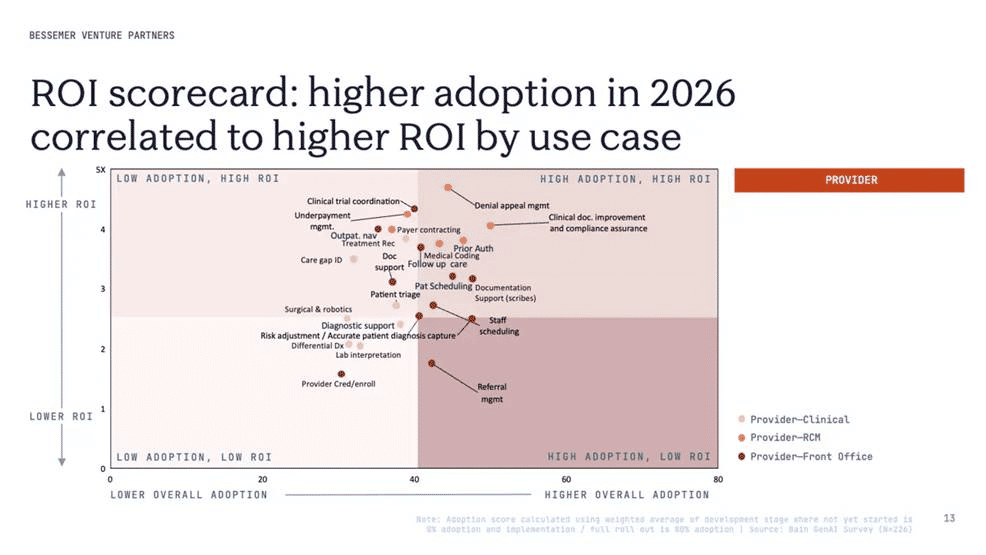
Figure 1. Provider AI use cases mapped by adoption and realized ROI.
Source: Bessemer Venture Partners and Bain & Company, The 2026 Healthcare AI ROI Scorecard; Bain GenAI Survey, N=226.
Scale the revenue cycle workflows already combining adoption and return. | Scale Proven Workflows
Denials should become a prevention system, not a faster appeal queue.
Denial and appeal management is a scale-ready workflow with measurable potential. HFMA reported in 2026 that about one in five providers applied AI to denials management, showing that strong potential does not equal universal maturity. Leaders should use AI to prioritize work and assemble evidence, then feed denial intelligence upstream into eligibility and benefits verification, prior authorization and clean-claim controls. Otherwise, AI merely accelerates rework.
CDI and coding need accuracy before autonomy.
Clinical documentation improvement and compliance assurance, prior authorization and medical coding are also strong candidates for selective scale. AHIMA noted in 2024 that weak documentation and coding quality can drag down AI performance. Scale should therefore pair clinical documentation integrity with medical coding, audit controls and expert validation. The goal is not touchless work at any cost. It is defensible first-pass performance that reduces corrections after submission.
Validate high-return opportunities before the industry normalizes them. | Validate Emerging Opportunities
Underpayment management combines promising returns with room for wider adoption. That makes underpayment recovery and payer variance resolution a candidate for controlled validation: establish a baseline, define recoverable variance, account for implementation cost and test whether detection converts into cash. Likewise, leaders should connect revenue integrity and leakage prevention to contract intelligence and payment outcomes rather than treating alerts as value.
Investigate adopted workflows that are not returning enough.
Patient scheduling and referral management require a sharper outcome definition. That does not make either workflow unimportant. It means leaders should sharpen the outcome definition. For scheduling and registration, is AI improving completed appointments, registration quality or staff capacity? For patient access management, is automation preventing downstream denials or simply moving more tasks? Adoption without an explicit financial and operational path can make a busy workflow look successful while the revenue cycle still cleans up its defects.
Build an AI portfolio instead of collecting disconnected tools. | Build The AI Portfolio
The American Hospital Association reported in 2024 that 46% of hospitals and health systems used AI in RCM and 74% used some form of revenue cycle automation. The harder question is: which investments can scale into governed execution? Connect claims editing and clean-claim validation, accounts receivable follow-up and payment posting and reconciliation through shared data, priorities and outcome measures. Revenue cycle platforms should be judged by whether intelligence becomes action, experts receive the right exceptions and leaders can see what changed.
Use this executive dashboard to decide what scales next. | Use The Decision Dashboard
The following framework converts adoption and ROI into four decisions.
Open accountability turns AI activity into durable performance.
Before scaling, ask five questions: What measurable problem is being solved? What baseline defines realized improvement? What can AI execute without intervention? Which exceptions require expert judgment? Can every action, error and outcome be traced? Those questions align AI investment with First-Pass Performance and Open Accountability. They also prevent technology from hiding fragmented ownership. The strongest portfolio does more than recover revenue faster. It learns from downstream failures, corrects upstream causes and gives the provider visibility and control.
The next revenue cycle AI advantage will come from selective scale.
Every revenue cycle AI use case does not scale equally. The framework helps leaders distinguish proven workflows, under-adopted opportunities and applications that need redesign. A practical next step is to assess each use case against financial value, rework reduction, execution readiness, autonomy potential and governability. That is how health systems move from isolated pilots to scaling with technology, reducing cost to collect and accelerating cash. This physician enterprise case study illustrates the value of treating revenue cycle as a learning system rather than a sequence of disconnected queues.

Frequently asked questions
Which revenue cycle AI use cases should healthcare providers prioritize?

What does high ROI but low adoption mean for a revenue cycle workflow?
How should a revenue cycle leader measure AI ROI?
What is the difference between revenue cycle management automation and AI agents?
Why can an adopted revenue cycle AI workflow still show weak ROI?
How can healthcare providers avoid disconnected revenue cycle AI tools?
Extend performance across connected outcomes.



Revenue cycle thinking for leaders who need fewer surprises.
Explore Vee Healthtek perspectives on the forces reshaping revenue cycle performance, healthcare operations, technology adoption, and financial resilience.



Find which revenue cycle AI workflows you should scale.
Request a diagnostic to find where AI can reduce rework, strengthen first-pass performance and create measurable RCM outcomes while you keep its operational control.
Continue exploring expert perspectives, industry trends, and practical strategies for improving revenue cycle performance.
Explore Points Of View