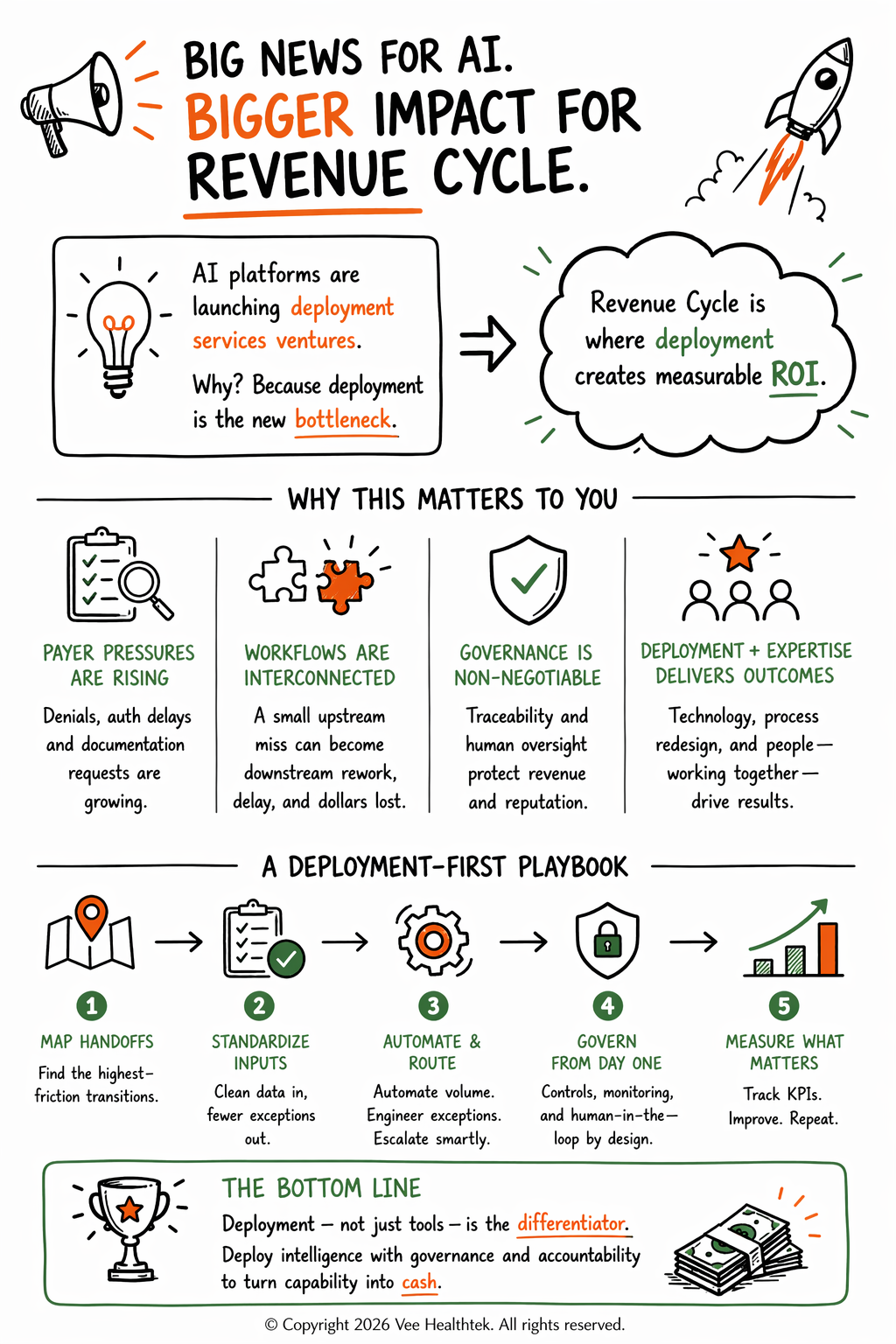

In May 2026, two frontier AI platforms announced new PE-backed services ventures designed to help enterprises move from pilots to production. The signal was important: the market agrees that AI’s value depends as much on deployment, workflow redesign, and scaling discipline, plus the governance required to make automation safe and auditable, as much on model access.
This matters immediately to health systems because Revenue Cycle Management (RCM) is one of the most workflow-dense, exception-heavy operating environments in the enterprise. Revenue cycle performance is determined by how reliably information, decisions, and supporting evidence move across patient access, documentation, coding and billing, claim submission, payer follow-up, remittance, and patient responsibility. Put simply, revenue cycle does not struggle for lack of tools; it struggles when handoffs break, rules vary, and work is pushed from one queue to another.
TL;DR
- AI services ventures exist because scaling requires implementation capacity, not just tools.
- In revenue cycle, the most valuable improvements come from fixing handoffs and reducing exceptions across workflows.
- Sustainable gains require governance, measurable metrics, and a deployment-first operating model.
What Revenue Cycle Management Is
Revenue Cycle Management is the set of processes health systems use to track revenue from the patient’s initial encounter through claim submission, reimbursement, and final balance resolution. The cycle is linked end to end: a small upstream variance can become a denial, a rework loop, a delayed remittance, or a poor patient financial experience downstream.
That is why optimizing a single function in isolation rarely solves the broader operating problem. The AMA’s workflow guidance makes the same point in practical terms: revenue cycle performance depends on disciplined workflows, clean claims, checkpoints, and active follow-up across the lifecycle.
What The Services-Venture Trend Implies For Revenue Cycle Operations
First, buying criteria are shifting from feature lists to deployment capacity. Health systems will increasingly judge partners on integration into systems of record, practical change management, and time-to-value because implementation is now the bottleneck. That aligns with broader enterprise findings that the organizations realizing more value are the ones that redesign workflows around new capabilities, rather than layering technology onto legacy operating habits.
Second, exception-handling becomes the heart of the operating model. Payer pressures, including denials, prior authorization delays, unclear rationales, and documentation demands raise the cost of ambiguity. That means leaders need more than task automation. They need standard work, intelligent routing, evidence assembly, and clear escalation paths that prevent work from ricocheting across teams.
Third, governance moves from an IT concern to a revenue-protection discipline. As automation becomes more agentic, scaled use requires controls, monitoring, and explicit human validation points. Revenue workflows are financial and auditable by nature, so black box automation is not enough. The approach has to be traceable, governable, and explainable in day-to-day operations.
Fourth, hybrid delivery models become more attractive. The recent news about services ventures mirrors a reality revenue cycle leaders already know: the best outcomes often come from combining technology with embedded expertise that can resolve exceptions, redesign workflows, and reinforce accountability.
The competitive advantage comes from deploying intelligence into workflows with governance, so throughput improves without simply shifting work into new queues.
A Deployment-First Playbook For Revenue Cycle Leaders
Start by mapping the highest-friction handoffs rather than evaluating departments in isolation. Then standardize the inputs that create avoidable downstream volatility - eligibility, authorization, documentation readiness, coding integrity, and claim preparation.
Use automation for repeatable volume work but engineer exception handling for payer variability and clinical nuance. Build governance from day one: logs, access controls, monitoring, and human-in-the-loop rules should be treated as operating requirements, not post-implementation clean-up.
Finally, measure in CFO language. Baseline the operational metrics that matter, then track sustained movement after redesign and adoption. Durable value depends on disciplined scaling and governance is a critical enabler as deployment broadens.
A practical discipline here is metric design. Health systems should decide upfront which indicators prove that the deployment is improving the operating model: clean claim rate, denial friction, days in A/R, appeal cycle time, preventable write-offs, and cost-to-collect are more meaningful than counting automations launched. That keeps teams focused on business outcomes rather than activity volume, and it gives finance, operations, and IT a shared scorecard for discussing progress and accountability.
Rather than asking, “Where can AI automate a task?” CFOs and Revenue Cycle Leaders should ask, “Where can a deployment-ready operating model reduce friction across revenue cycle handoffs?” That is how capability turns into reliability, resilience, and financial performance.
Decision Checklist
- Where can the approach integrate with EHR, clearinghouse, and payer workflows, with auditable logs?
- Where will it reduce exceptions across handoffs, not just automate one task?
- What governance controls are built in: role-based access, monitoring, and human validation?
- What is the implementation capacity to move from pilot to production?
- How does the model address payer friction with playbooks and continuous improvement?
Bottom Line
The real takeaway from the recent services-venture announcements is not that AI vendors are adding consulting revenue. It is that deployment is now the differentiator. For revenue cycle leaders, that means the winners will not be the organizations with the most tools. They will be the ones that can deploy intelligence into revenue cycle operations with governance, measurable accountability, and enough operating discipline to translate capability into cash.