
Hospital price transparency is often discussed as a compliance requirement that started years ago. That is exactly why many finance leaders risk underestimating its importance in 2026. The original rule may date back to 2021, but CMS began enforcing the new 2026 hospital price transparency requirements on April 1, 2026. At the same time, CMS has made clear that hospitals must ensure their machine-readable files conform to the revised standards. For CFOs and Revenue Cycle leaders, that means hospital price transparency is no longer just a policy obligation. It is now a live test of pricing data quality, reimbursement logic, and patient estimate readiness.
What Changed In 2026
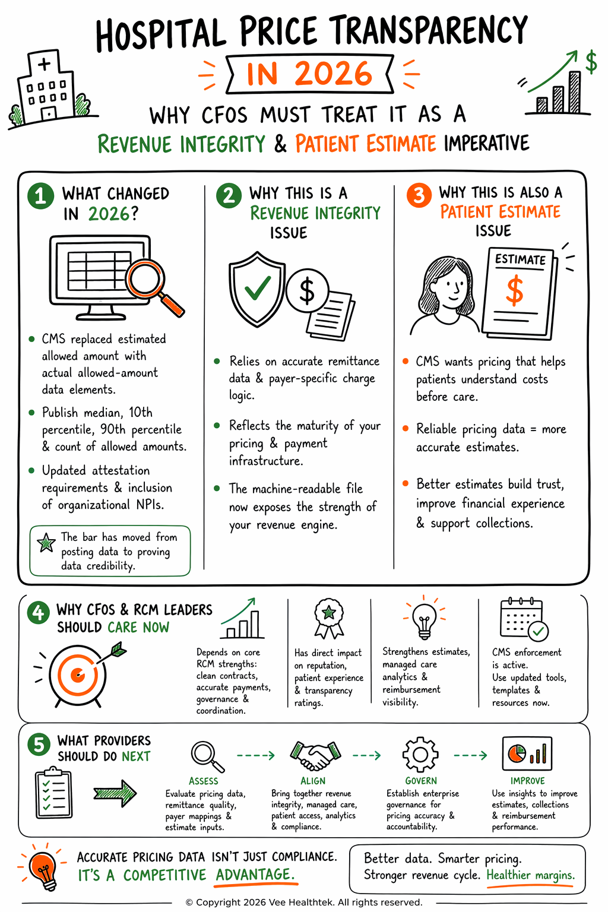
The reason this topic is relevant now is that the operating standard changed. In the CY 2026 OPPS and ASC final rule, CMS replaced the earlier estimated allowed amount approach with more precise allowed-amount data elements. Hospitals are now expected to publish the median allowed amount, the 10th percentile allowed amount, the 90th percentile allowed amount, and the count of allowed amounts used in the calculation. CMS also updated attestation requirements and required inclusion of organizational NPIs in the machine-readable file. These changes raise the bar from posting data to proving data credibility.
That matters because these changes are not abstract regulatory edits. They are operationally demanding. The new disclosures depend on payer-specific charge logic, remittance-derived calculations, and consistent source-data governance. If those building blocks are weak, the resulting transparency file will be incomplete, inaccurate, or difficult to defend. In practical terms, the file has become a byproduct of revenue cycle discipline.
Why This Is Now A Revenue Integrity Issue
Hospital price transparency now sits much closer to revenue integrity than many organizations realize. To produce the required pricing outputs, hospitals must accurately interpret payer reimbursement, connect remittance data to item and service definitions, and maintain dependable pricing logic across contracts and plans. Those are not compliance-only tasks. They sit squarely inside the financial operating model of the healthcare provider.
For CFOs, this changes the leadership question. The issue is no longer whether the organization has a file posted online. The real question is whether the healthcare providre can produce pricing data that is traceable, supportable, and aligned with how reimbursement actually works. Revenue integrity leaders, managed care leaders, and revenue cycle leaders should all recognize that the machine-readable file now exposes the maturity of the underlying pricing and payment infrastructure.
Why This Is Also A Patient Estimate Issue
The topic also matters because price transparency and patient estimates are increasingly part of the same conversation. CMS has consistently emphasized that hospital price transparency should help patients understand what care may cost before they receive it. That goal cannot be achieved if the data behind payer-specific charges is unreliable or disconnected from the estimate logic used at the front end of the revenue cycle.
When estimate inputs are weak, patients receive financial guidance that may be technically available but not practically useful. That creates avoidable confusion before service, weakens trust in financial communication, and makes it harder for organizations to improve collection performance in a consumer-sensitive way. In contrast, healthcare providers that treat pricing data as an enterprise capability are better positioned to deliver clearer estimates, more predictable conversations, and stronger patient financial experience.
Why CFOs And Revenue Cycle Leaders Should Care Now
This issue deserves executive attention for three reasons. First, transparency accuracy now depends on the same operational muscles required for effective revenue cycle performance: clean contract logic, accurate payment interpretation, dependable data governance, and cross-functional coordination. Second, pricing transparency now has direct reputational and patient experience implications, not just regulatory implications. Third, the organizations that strengthen pricing accuracy today will also strengthen adjacent capabilities such as patient estimates, managed care analytics, and reimbursement visibility.
Recent CMS resources underscore that hospitals should make sure their machine-readable files conform to the new requirements and use the updated templates, tools, and validator support now available. That means the work is immediate, not theoretical. Finance and Revenue Cycle Management leaders should view this as a current operating priority that belongs on the executive agenda. CMS provides updated hospital price transparency resources and tools here.
What Healthcare Providers Should Do Next
A strong response starts with a practical assessment of pricing data readiness. Hospitals should evaluate whether remittance data, payer mappings, charge logic, and contract interpretation are robust enough to support the new allowed-amount disclosures. They should also assess whether patient estimate workflows are drawing from the same dependable source logic that underpins transparency reporting. If those processes sit in different silos, leaders should close the gap quickly.
The next step is governance. Price transparency should not be owned as a narrow website-publishing task. It should be managed as a cross-functional financial capability spanning revenue integrity, managed care, patient access, analytics, and compliance. The hospitals most likely to succeed will be those that align these functions around a shared definition of pricing accuracy and a shared accountability model for sustaining it over time.
Conclusion
Hospital price transparency in 2026 is relevant because the enforcement environment changed, the data requirements became more precise, and the operational implications became much broader. This is no longer just about posting a file. It is about whether the healthcare provider’s pricing and reimbursement engine can support accurate, comparable, and patient-relevant pricing information. For CFOs and Revenue Cycle leaders, that makes transparency a finance and operations priority. The organizations that recognize this shift now will be better positioned to strengthen revenue integrity, improve patient estimates, and lead with more confidence in an increasingly data-driven reimbursement environment.
How We Can Help
Vee Healthtek helps healthcare providers strengthen pricing accuracy and avoid rework by aligning revenue integrity, analytics, and modular Revenue Cycle operations to support cleaner transparency data and more dependable patient estimates. When the revenue cycle is resilient, clinicians can better focus on care and patients progress with confidence.