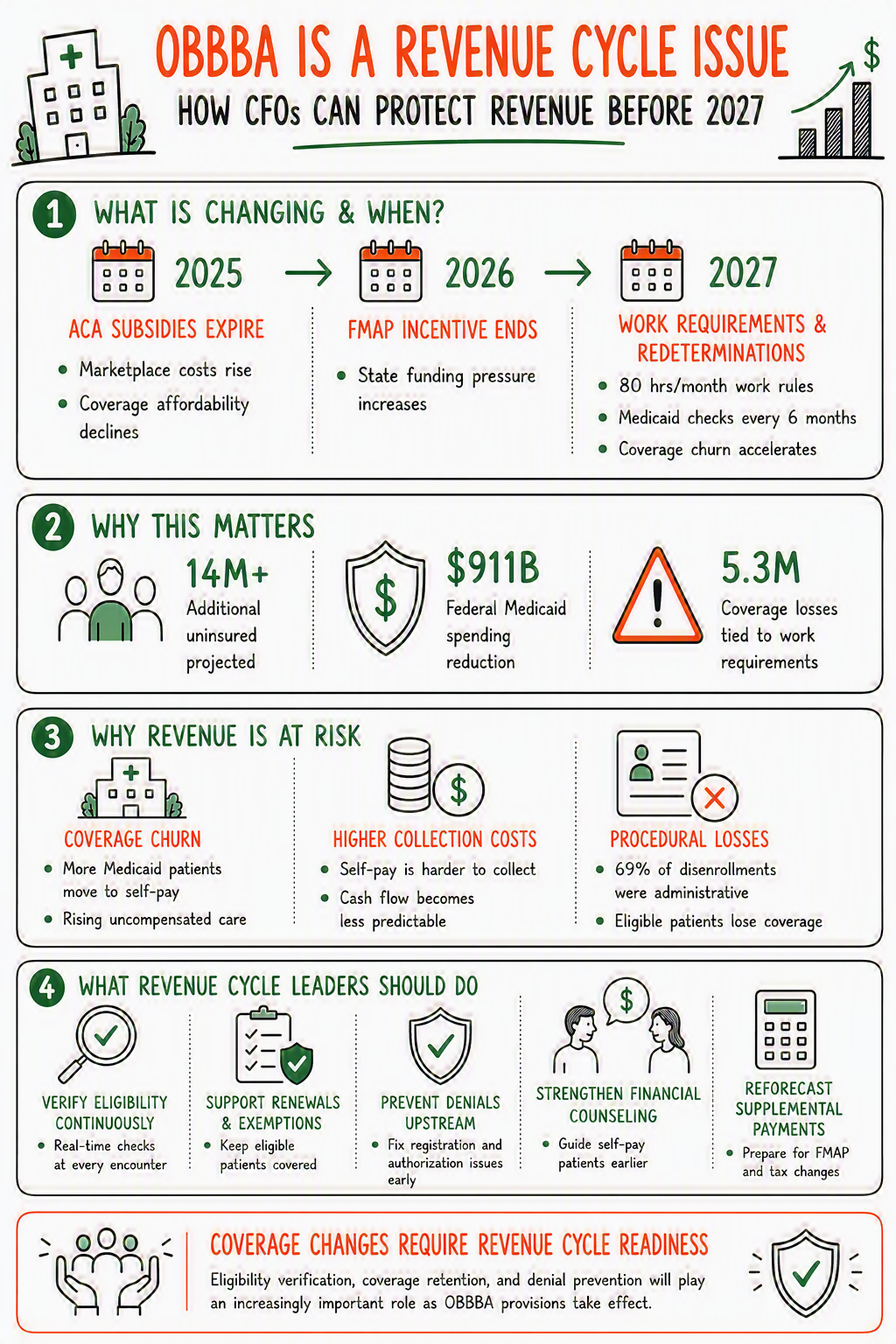

The One Big Beautiful Bill Act (OBBBA) is often treated as a 2027 problem - a set of Medicaid changes that take effect down the road. That is exactly why many finance leaders risk underestimating its impact on the revenue cycle today. The heaviest provisions do land in 2027, but the coverage shift has already begun: the ACA’s enhanced premium tax credits expired at the end of 2025, and the law is projected by the Congressional Budget Office to cut federal Medicaid spending by $911 billion over a decade and increase the uninsured by 10 million by 2034, rising to more than 14 million once the subsidy expiration is counted. For CFOs and Revenue Cycle leaders, OBBBA is a live test of eligibility, coverage retention, self-pay readiness, and denial prevention.
What Is Changing and When
The clock is specific, and each provision translates into a front-end operational demand, not just a budget line:
| Provision | Effective Date | Revenue Cycle Implication |
|---|---|---|
| Enhanced ACA premium tax credits expire | End of 2025 (in effect) | Marketplace premiums jump and coverage drops; self-pay and uncompensated care rise |
| FMAP expansion incentive ends | 2026 | Less federal support for expansion; added state financing pressure |
| Medicaid work / community-engagement requirements (80 hrs/month, expansion adults) | January 1, 2027 (states may begin earlier; HHS interim rule due June 2026) | Exemption tracking and coverage-retention outreach |
| Frequent (six-month) Medicaid redeterminations for expansion adults | January 1, 2027 | Continuous, real-time eligibility verification; churn management |
| Provider tax safe-harbor reduction and state-directed payment limits | New taxes barred at enactment; safe-harbor reduction from Oct. 1, 2027 | Re-baseline supplemental-payment assumptions |
The eligibility provisions carry the heaviest weight: the work requirements alone account for the largest projected coverage loss, about 5.3 million people, and begin January 1, 2027, with states needing major systems and workforce changes to be ready.
Why Revenue Is at Risk
- Coverage churn moves accounts from Medicaid to self-pay. As redeterminations tighten and work requirements take hold, patients drop off Medicaid -and many drop subsidized Marketplace coverage as premiums rise.More than 10.3 million people are likely to lose Medicaid, and the combined uninsured increase exceeds 14 million by 2034. Those patients do not stop needing care; they arrive uninsured.
- Self-pay is significantly harder and costlier to collect. Even today, McKinsey finds the revenue cycle typically costs an at-scale health system 3 to 4 % of revenue, with systems collectively spending more than $140 billion a year just to get paid. A larger uninsured and self-pay population makes collection slower, more expensive, and less certain- and pushes uncompensated care up.
- Procedural disenrollment creates avoidable revenue loss. During the post-pandemic Medicaid unwinding, more than 25 million people were disenrolled, and 69% lost coverage for paperwork or procedural reasons rather than being found ineligible. A KFF survey found nearly two-thirds of enrollees had no change in income or circumstances that would have made them ineligible. Much of the coming loss is administrative, not inevitable -which is exactly why it can be protected against.
HFMA reaches the same conclusion: under OBBBA, it argues, coverage retention and accurate exemption management have become core revenue-cycle performance measures, and automated, continuous eligibility verification is now foundational to keeping records aligned with state systems and reducing avoidable disenrollments.
What Revenue Cycle Leaders Should Do
A strong response starts at the front end and works backward through the cycle:
- Verify eligibility continuously. Coverage can change between visits -verify in real time at every encounter and reconcile against state systems.
- Build renewal and exemption workflows. Proactive outreach and exemption tracking keep eligible patients enrolled. With work requirements verified at application and at each renewal, this is the highest-yield revenue action available under OBBBA.
- Prevent denials upstream. HFMA reports that roughly 15% of claims are initially denied, about 90% of denials are preventable, and nearly half are linked to front-end functions such as registration, eligibility verification, and authorization. Fix those defects before the claim is created.
- Strengthen financial counseling. A larger self-pay population needs earlier, clearer financial navigation and assistance screening.
- Budget now for financing pressure. The FMAP expansion incentive ends in 2026 and the provider tax safe-harbor reduction begins October 1, 2027 - quantify the effects on supplemental payments early.
How Technology Should Respond
OBBBA’s failure points are specific, so the technology response should be too. Four capabilities do most of the work:
- Real-time eligibility and coverage discovery: Checking coverage at every encounter and surfacing active coverage at registration, not after the denial arrives.
- Renewal and documentation support: Calendar-driven outreach, exemption tracking, and documentation workflows that keep eligible patients enrolled through six-month cycles and work-requirement reporting.
- Predictive denial prevention: Flagging the registration, eligibility, and authorization defects most likely to trigger a denial and resolving them before submission.
- Human-in-the-loop oversight and auditability: Automation clears the clean volume while trained staff handle exemptions, frailty, and conflicting documentation, with every decision explainable and auditable.
Technology alone is not the answer, and the record proves it: McKinsey notes that despite billions invested in automation, most health systems still rely on manual billing work across a patchwork of loosely connected systems. Tools deliver only when integrated into governed workflows with people accountable for the exceptions - and under OBBBA, the exceptions (exemptions, documentation timing, status changes between renewals) are exactly where eligible patients are lost.
Conclusion
OBBBA changes the operating environment for the revenue cycle, not just the budget. The dates are fixed, the coverage shift is already underway, and the pressure concentrates at the front of the cycle. But because so much of the loss is procedural, much of it is preventable. The organizations that act now - tightening eligibility, retention, and denial prevention before 2027 - will protect more revenue in 2027 and beyond and carry steadier margins and stronger patient trust into the years that follow.
How We Can Help
Vee Healthtek helps health systems protect revenue through continuous eligibility verification, real-time coverage discovery, and proactive renewal and exemption support. Our teams help keep patient records aligned with state systems, reduce avoidable coverage loss, and minimize eligibility-related denials.
By combining revenue cycle expertise, technology-enabled workflows, and operational governance, we help organizations strengthen coverage retention, improve front-end performance, and support compliant, auditable processes.