


Showing items3 of 6

AI in CPT Coding needs human expertise to protect accuracy
AI-powered CPT Coding can accelerate routine decisions. | AI-assisted CPT Coding
Current Procedural Terminology coding converts documented medical services and procedures into standardized claim information. AI-powered Coding applies technologies such as artificial intelligence, natural language processing and machine learning to review documentation, identify relevant evidence, recommend codes or modifiers and route encounters for validation. The goal should not be automation for its own sake. It should be faster, more consistent coding without weakening documentation support, compliance or reimbursement integrity.
KLAS Research reported in 2025 that organizations adopting autonomous coding describe higher efficiency and reduced staff strain, particularly in high-volume, relatively standardized specialties such as radiology and emergency medicine. It also noted functionality gaps in some specialties and limited transparency around vendor road maps. That combination explains why healthcare providers need selective automation, measurable guardrails and expert review.
Automation helps when coding work is repetitive and evidence is clear. | Where Automation Helps
AI can organize the record before code selection.
AI can extract relevant phrases, surface procedure details and connect dispersed documentation for review. This reduces time spent searching a chart and can help clinical documentation integrity teams identify missing specificity earlier. The benefit is not that the model “understands” the encounter like a clinician or coder, but that it makes pertinent evidence easier to evaluate.
AI can recommend codes and modifiers for validation.
Computer-assisted and AI-enabled coding can propose CPT codes, associated modifiers and supporting evidence. In stable, well-documented workflows, high-confidence recommendations may reduce manual searching and improve coder throughput. Lower-confidence, high-value or payer-sensitive cases should move to a qualified reviewer rather than directly to billing.
AI can surface exceptions before submission.
Models and rules can flag inconsistencies between documentation, charges, code combinations and payer requirements. Connected claims editing and clean-claim validation then prevent avoidable defects from becoming denials. Used well, automation removes repetitive review. Used poorly, it adds another queue and shifts rework downstream.
Human expertise still matters when context changes the answer. | Where Experts Matter
Ambiguous documentation requires professional judgment.
A code recommendation is only as defensible as the source record. Coders must determine whether documentation supports the service, level, time, units and modifier reported. When evidence is incomplete or contradictory, trained professionals should query, clarify and apply official guidance rather than accept a statistically likely answer.
Complex encounters require clinical and payer context.
Specialty rules, unusual procedures, multiple services, coverage policies and site-of-service requirements can change the correct coding decision. Medical coding professionals interpret these dependencies and recognize when an apparently plausible recommendation creates compliance or reimbursement risk. Human review is especially important where errors could produce undercoding, overcoding or audit exposure.
Quality teams must distinguish speed from accuracy.
Coding audits and quality assurance should test model output against documentation, coding rules and final claim outcomes. Override patterns can reveal weak model logic, inconsistent coder adoption or documentation gaps. The evidence should then improve workflows, education and configuration rather than remain trapped in an audit report.
A human-in-the-loop model keeps automation accountable. | Human-in-the-loop Framework
Use automation where evidence is clear and direct expert attention where risk or ambiguity is high.
Governance determines whether AI improves coding quality. | Governance and Measures
AHIMA’s 2024 autonomous-coding framework describes coding automation as collaboration between coding professionals and machine-learning processes, with coders retaining ownership of final code assignment and documentation stewardship. For CPT coding, the same principle applies: define which encounters can be automated, which require review and which must never bypass expert validation.
Governance should establish approved use cases, documentation thresholds, confidence bands, audit sampling, override rules, escalation paths and change control. EHR integrations should bring evidence, suggestions and edits into the coder’s existing workflow. Open accountability makes model behavior, exceptions, owners and corrective actions visible before defects compound.
The right measures connect automation to coding outcomes.
Leaders should track accuracy, coder acceptance and override rates, turnaround time, coding-related edits, denials, audit findings and financial variance. First-pass performance improves when the code is supported, validated and claim-ready before submission, not merely assigned faster. For HIM, coding, CDI and mid-cycle leaders and heads of revenue cycle, measures should be segmented by specialty, payer, model version, risk tier and workflow.
The strongest operating model combines automation speed with accountable expertise. It can help providers scale with technology, accelerate cash, reduce cost to collect and improve revenue integrity. Human judgment is not a temporary bridge until AI becomes more capable. It is the control that ensures AI-supported coding remains accurate, explainable and defensible.
Supporting controls may include charge capture optimization, revenue integrity and leakage prevention, billing compliance and audit defense and denials management and appeals. Together, these controls prevent technology-driven coding defects from becoming avoidable payment delays or repeated rework.

CPT Coding errors delay and reduce reimbursement
Why do CPT coding errors affect reimbursement? | Why Coding Errors Matter
Current Procedural Terminology (CPT) Coding translates documented professional services and procedures into standardized claim information. When the reported code, modifier, documentation and payer rule do not align, a claim can be edited, denied, downcoded or paid below the amount earned. The immediate financial effect matters, but so does the operating burden: coders, billers and denial specialists must research and correct work that should have moved cleanly the first time.
Providers can reduce this exposure by treating medical coding as a connected revenue cycle control rather than an isolated production task. The following ten risks show where preventable defects commonly enter the workflow and how to stop them before submission.
Which CPT coding errors delay or reduce payment? | Ten Reimbursement Risks
1. Using outdated CPT information.
Annual code changes can add, revise or delete codes and guidance. If reference content, EHR logic or charge tools are not updated, claims may carry invalid or inaccurate information. Establish a controlled update calendar, test affected workflows and educate teams before new rules take effect.
2. Reporting services unsupported by documentation.
A code must be defensible from the medical record. When the note does not establish the service, level, time or clinical detail reported, the claim faces payer review and compliance exposure. Strong clinical documentation integrity and timely queries close gaps before billing.
3. Missing or misapplying modifiers.
Modifiers explain circumstances that affect how a service should be interpreted. An omitted modifier may reduce payment, while an unsupported modifier can trigger an edit, denial or audit. Specialty-specific guidance and focused modifier audits help teams apply them consistently.
4. Unbundling component services.
Reporting components separately when coding or payer rules require a bundled service can overstate reimbursement and attract scrutiny. Encounters should pass through current edit logic before claim release. Exceptions need documentation and accountable review rather than routine override.
5. Undercoding documented care.
Conservative coding is not automatically compliant coding. Missed procedures, incomplete charge capture or selection below the documented service can leave earned revenue unbilled. Coding audits should look for both overcoding and undercoding.
6. Overcoding the service performed.
Selecting a higher-level or more complex service than the record supports creates repayment and audit risk. Quality review should test code selection against the complete encounter, not only a template or problem list. Targeted education should address patterns at their source.
7. Confusing CPT and HCPCS requirements.
CPT forms HCPCS Level I, while HCPCS Level II reports products, supplies and services not included in CPT. Choosing the wrong code set can create mismatches and nonpayment. Coders should validate the service, setting and payer-specific billing requirement.
8. Missing medical-necessity alignment.
A correctly selected procedure code can still be denied when the diagnosis, coverage policy or supporting record does not establish medical necessity. Prebill validation should connect coding, documentation and payer policy. This reduces avoidable handoffs into appeals.
9. Ignoring specialty and site variation.
Coding requirements can change by specialty, place of service and care setting. Generic edits may miss a procedure-specific risk or create false positives. Governed specialty playbooks and calibrated quality sampling improve consistency without slowing every encounter.
10. Failing to learn from denials.
Working denials one account at a time recovers some cash but does not prevent recurrence. Trend analysis should connect denial reason, code, modifier, payer, clinician and workflow stage. Closed-loop corrective action converts each denial into a prevention signal.
These controls become stronger when clinical documentation integrity, charge capture optimization, coding audits and quality assurance and claims editing and clean-claim validation share the same defect taxonomy and escalation path.
Where CPT coding errors become reimbursement risk. | Prevent Recurring Defects
A simple control framework for preventing defects before they become denials, underpayments or rework.
How can providers prevent recurring CPT coding errors? | Measure Coding Quality
Prevention starts by measuring where work fails and who can fix the source. Computer-assisted and AI-enabled coding can prioritize exceptions, surface missing evidence and identify variation, but recommendations still require governed validation. EHR integrations and AI-powered Revenue Cycle Execution Ecosystems such as RevAmp bring relevant evidence and rules into the workflow instead of creating another disconnected queue.
First-pass performance improves when documentation, coding, charging and claim edits are designed to complete work correctly upstream. That reduces repeated touches across denials management and appeals and accounts receivable follow-up. Open accountability makes accuracy, backlog, denial trends, owners and corrective actions visible, so recurring defects cannot hide inside departmental handoffs.
For HIM, coding, CDI and mid-cycle leaders and heads of revenue cycle, the most useful measures connect coding quality to financial outcomes: first-pass claim acceptance, coding-related denials, modifier error rates, avoidable touches, turnaround time and recovered leakage. This visibility helps organizations accelerate cash, reduce cost to collect, and improve revenue integrity.
The goal is not to eliminate every payer challenge. It is to remove preventable provider-side defects, preserve defensible reimbursement and focus expert attention on true exceptions. A governed DRG validation program illustrates the operating principle: visible production control, closed-loop quality analytics and prebill review can protect cash without turning quality into a downstream inspection step.

Current procedural terminology (CPT) coding builds cleaner claims
What is current procedural terminology coding? | CPT Coding Explained
Current Procedural Terminology (CPT) Coding assigns standardized five-digit codes to medical services and procedures documented by physicians and other qualified healthcare professionals. The American Medical Association maintains the CPT code set, which gives providers, payers and regulators a shared language for describing care. In the revenue cycle, that language connects clinical documentation to charge capture, claim creation, payer adjudication and payment.
For healthcare providers, CPT coding is more than code selection. A code must reflect the service performed, documentation available, applicable guidance and any required modifiers. When those elements align, medical coding supports cleaner claims and more predictable reimbursement. When they do not, the account may return for clarification, edits, correction or appeal, creating avoidable rework.
Why does CPT coding matter to healthcare providers?
CPT coding affects whether a claim accurately communicates the care delivered. Precise coding can support compliant reimbursement, reliable utilization reporting and clearer payer communication. It also strengthens revenue integrity and leakage prevention by helping organizations identify missed, unsupported or inconsistent charges before bill release.
The operational impact extends across the cycle. Documentation ambiguity may trigger a coder query. An incorrect modifier may create a claim edit. A mismatch between the procedure and diagnosis may lead to payer review. Strong clinical documentation integrity, charge capture optimization and claims editing and clean-claim validation reduce these downstream touches.
What are the three CPT code categories? | Code Categories
Category I codes.
Category I codes describe widely performed services and procedures that meet established criteria. They represent most routine CPT coding activity across evaluation and management, anesthesia, surgery, radiology, pathology and laboratory, and medicine services.
Category II codes.
Category II codes are optional tracking codes used primarily for performance measurement. They can help organizations capture information about care processes and quality without replacing Category I codes required to report the underlying service.
Category III codes.
Category III codes support data collection for emerging technologies, services and procedures. Because code status does not determine coverage, providers should separately verify payer policy, medical necessity requirements and reimbursement rules.
How does the CPT coding process work? | Coding workflow
The process begins with complete clinical documentation. A coder reviews the encounter, identifies the documented services, applies current coding guidance, evaluates modifiers and validates the code against the record. The coded encounter then moves through edits, charge review and claim preparation before submission.
High-performing organizations manage this as a connected workflow rather than an isolated coding task. They clarify ambiguous documentation early, direct exceptions to the right specialist and analyze repeat defects. That supports First-pass performance: completing work correctly upstream so downstream teams do not have to rescue it. For HIM, coding, CDI and mid-cycle leaders, useful metrics include coding accuracy, turnaround time, query rates, edit rates and coder-level variation.
How does CPT coding build a cleaner claim? | Related Code Sets
A five-control framework for completing coding work correctly before claim submission.
How are CPT, ICD-10-CM and HCPCS different?
CPT codes generally describe professional services and procedures, while ICD-10-CM codes describe diagnoses and the clinical reasons for care. CMS explains that CPT forms HCPCS Level I, while HCPCS Level II identifies products, supplies and services not included in CPT, such as certain ambulance services and durable medical equipment. A claim may require codes from more than one system, but each code set answers a different question.
How do modifiers and documentation affect CPT coding?
Modifiers add context about how a service was performed without changing its core definition. Their use must be supported by documentation and aligned with current payer requirements. Missing, incorrect or unsupported modifiers can distort the claim, delay adjudication or create compliance risk.
Documentation must make the reported service defensible. Effective programs connect coder feedback with clinician education and coding audits and quality assurance. They also use EHR integrations and governed workflows to present the right evidence at the right decision point, rather than adding another review queue.
How can providers improve CPT coding accuracy? | Accuracy and Performance
Providers can improve performance by maintaining current code-set access, standardizing specialty guidance, auditing high-risk encounters and closing feedback loops across documentation, coding, billing and denials. Computer-assisted and AI-enabled coding can prioritize records or flag exceptions, but technology-generated suggestions still require validation against clinical evidence and coding rules.
Leaders should connect coding quality to outcomes, including first-pass claim acceptance, denial trends, avoidable touches and cost to collect. Open accountability makes performance, emerging risk and corrective action visible before problems compound. This operating discipline can help heads of revenue cycle accelerate cash, reduce cost to collect and improve revenue integrity without normalizing correction work as business as usual.

Mid-sized health systems need a different RCM model
Mid-sized health systems carry enterprise-level revenue cycle complexity without enterprise-level redundancy. Multiple facilities, specialties, payer contracts, and technology systems create the same need for specialized expertise found in larger organizations, while smaller teams leave less capacity to absorb a backlog, employee departure, or change in payer behavior.
This imbalance makes the mid-sized health system revenue cycle financially distinct. Complexity extends across the organization, while expertise and available capacity often remain concentrated among a limited number of people. Protecting cash therefore requires a revenue cycle management model built around earlier capacity signals, shared decision logic, and scalable execution before a local disruption affects billing or payment.
Mid-sized complexity requires a tailored operating model. | The Mid-Sized Operating Gap
Mid-sized systems occupy a distinct position between smaller providers and large enterprises. They may support hospitals, physician groups, and outpatient locations across different payer environments without maintaining dedicated specialist coverage for every facility or revenue cycle function. Their operating model needs enough flexibility to preserve local knowledge while promoting consistent performance across the organization.
A team may have sufficient capacity for routine eligibility, authorization, coding, or billing work while relying on one or two experienced employees to resolve complex exceptions. Staffing can therefore appear adequate even when coverage for payer-specific edits or specialty workflows remains limited.
This difference changes how leaders need to evaluate capacity. Headcount shows how many people work within a function. Coverage depth shows whether the system can maintain the decisions required to keep reimbursement moving. Understanding this distinction helps protect cash conversion and forecasting accuracy.
Margin pressure makes this issue more consequential. The American Hospital Association reported that labor represented 56% of hospital costs in 2024, while Medicare and Medicaid underpayments totaled $130 billion in 2023. Limited room to absorb disruption makes unresolved workflow problems financially significant.
Concentrated expertise can increase reimbursement exposure. | Concentrated Expertise Creates Exposure
Experienced employees often connect complex payer rules with local clinical and administrative workflows. One specialist may understand how an insurer applies authorization requirements to a particular service line. Another may know why documentation from one location repeatedly produces coding holds.
When this knowledge remains informal, coverage plans may replace processing capacity without replacing the judgment required for exceptions. Unresolved work can accumulate in authorization, documentation, coding, or billing queues. The financial effect appears when claims leave the workflow later or require added correction.
Exposure can extend across several parts of a mid-sized organization when the same specialist supports multiple facilities or specialties. Leaders can assess the dependency by asking:
- Which decisions require specialized payer or clinical knowledge?
- How much reimbursement depends on timely resolution?
- How many employees can complete the work independently?
- When will unresolved work begin to affect payment?
These questions reveal dependencies that volume measures can miss. They also help leaders decide where cross-training, workflow documentation, or added specialist capacity will provide the greatest financial value.
Local disruptions consume capacity across lean teams. | Local Disruptions Spread Quickly
Many mid-sized systems organize work by facility, specialty, or function to retain local expertise and clarify ownership. This structure can also make it difficult to see how an issue originating in one area consumes capacity elsewhere.
An eligibility error at one clinic may later become a claim edit, denial, and aged balance handled by different teams. Weaknesses in patient access management can create downstream corrections, while limited medical coding capacity can slow claims from a high-value specialty. Employees may eventually resolve each account, although repeated intervention increases the cost to collect.
This effect carries greater risk when resolving one backlog requires redirecting employees from another function. A contained issue can become a sequence of delayed handoffs through access, coding, billing, and A/R follow-up.
A connected operating model returns downstream findings to the workflow where the defect originated. Denial patterns can inform scheduling and registration changes, while payer variance can guide contract oversight and follow-up priorities. This feedback helps reduce revenue leakage without asking lean teams to correct the same problem repeatedly.
Capacity needs to be measured in financial terms. | Capacity Needs Financial Measures
A/R days and cash collections reflect work completed across prior weeks. Mid-sized systems benefit from earlier measures because they may have fewer available employees to redirect after a backlog begins affecting several functions.
Queue size alone provides an incomplete view. Two queues with the same account count may carry different financial exposure based on age, expected reimbursement, payer requirements, and the expertise needed for resolution.
Useful measures include:
- Queue age: Time work remains unresolved within each function.
- Specialist-dependent volume: Accounts requiring intervention from a limited group.
- First-pass exception rate: Work leaving the standard workflow for manual review.
- Coverage depth: Employees qualified to complete high-risk work independently.
- Cash at risk: Expected reimbursement attached to delayed accounts.
Segmentation by payer, facility, specialty, and process stage prevents enterprise averages from hiding local deterioration. One facility may accumulate coding holds while another experiences authorization delays, even when systemwide A/R remains stable.
Revenue resilience depends on distributing capability. | Resilience Requires Distributed Capability
Many mid-sized systems cannot maintain a separate specialist team for every revenue cycle risk. Building revenue resilience depends on identifying which capabilities require internal coverage and where the organization needs flexible access to additional expertise.
Cross-training provides value when employees can make the decisions involved, rather than process routine transactions alone. Effective coverage combines documented workflows with payer-specific decision logic and clearly defined escalation paths.
Leaders also need to distinguish temporary pressure from structural weakness. A short-term rise in A/R inventory may require added execution after an implementation or unexpected departure. Recurring backlogs may indicate upstream defects, unclear ownership, or insufficient specialist coverage.
Technology can strengthen this model when deployed inside a governed workflow. Revenue cycle technology working within existing systems can identify accelerating queues and recurring exceptions. McKinsey’s 2026 healthcare analysis identifies prior authorization, claims management, and medical records among the areas where healthcare organizations are applying AI.
Mid-sized systems can gain value when technology expands capacity without adding another disconnected queue or weakening practitioner oversight. A repeatable operating model can also scale revenue cycle capacity as the organization adds facilities, practices, or service lines.
How Vee Healthtek supports mid-sized health systems. | Vee Healthtek's Approach
Mid-sized health systems need a revenue cycle model designed for their balance of operational breadth and specialist depth. Financial exposure can grow when critical knowledge remains concentrated or when resolving one problem redirects capacity from another priority.
Vee Healthtek identifies where limited coverage, aging queues, and concentrated expertise create disproportionate reimbursement risk for mid-sized health systems. Practitioner-led analysis traces these pressures across facilities and functions to determine whether the underlying issue involves a temporary capacity gap, a recurring workflow defect, or specialist knowledge held by too few people. This distinction helps leaders address the source without shifting employees from another revenue-critical priority.
Scalable execution adds specialized depth where and when the organization needs it, while preserving leadership oversight across existing systems and governance structures. Open Accountability connects each intervention to measurable outcomes, including queue reduction, fewer repeated account touches, improved cash timing, and more predictable reimbursement. Mid-sized multi-facility health systems gain a flexible way to manage disruption and growth without creating a separate internal team for every payer, specialty, or revenue cycle exception.
Key takeaways
- Mid-sized systems manage broad revenue cycle complexity with fewer layers of specialist coverage.
- Staffing totals can conceal dependence on experienced employees who resolve high-risk exceptions.
- Local problems can spread when teams redirect limited capacity from another priority.
- Capacity measures provide greater decision value when connected to expected reimbursement.
- Distributed expertise and defined intervention triggers strengthen revenue resilience.

A revenue cycle management software buyer’s guide
Revenue cycle management software for healthcare providers. | RCM Software Explained
Healthcare revenue cycle management (RCM) spans the patient journey from scheduling and registration through verification, care delivery, claim submission, reimbursement and final account resolution. Revenue cycle management software connects and automates parts of that journey so healthcare providers can improve accuracy, productivity, cash flow and visibility.
Yet buying more technology does not automatically create a better revenue cycle. A platform can accelerate a well-designed workflow, but it can also multiply alerts, interfaces and work queues when processes, data and ownership remain fragmented. The right buying decision therefore starts with the operating problem, not the product demonstration.
What revenue cycle management software does.
Revenue cycle management software helps hospitals, health systems, physician enterprises and specialty providers manage financial and administrative work associated with patient care. Its scope may include patient access management, eligibility and benefits verification, prior authorization, charge capture, medical coding, claim submission, payment posting, denials, patient billing and accounts receivable follow-up.
The strongest platforms do more than digitize tasks. They validate data before it moves downstream, route exceptions to the right owner, preserve an audit trail and turn operational signals into actionable priorities. This ensures first-pass performance by helping teams complete work correctly upstream instead of repeatedly repairing the same account later.
Which RCM software capabilities matter most. | Core Software Capabilities
Front-office capabilities should prevent downstream defects.
Scheduling and registration tools should capture complete patient, guarantor and insurance information. Registration QA should detect missing or inconsistent fields before they create claim edits, denials or patient confusion. Financial clearance, estimates and authorization workflows should make exceptions visible while there is still time to resolve them.
Mid-office capabilities should protect claim integrity.
Coding, clinical documentation and charge capture tools should connect the record to a complete, compliant claim. Evaluate whether computer-assisted coding suggestions remain traceable to clinical evidence and whether coding audits and quality assurance feed recurring defects back into training and workflow design. AI can support coding and claim scrubbing, but the American Hospital Association notes that adoption remains concentrated in specific RCM functions, reinforcing the need for focused use cases and human oversight.
Back-office capabilities should convert signals into action.
Claims management software should support edits, submission, status tracking, payment posting and reconciliation, denials management and appeals and underpayment recovery. Dashboards matter only when users can move from a variance to the account, cause, owner, corrective action and outcome. That open accountability prevents unresolved exceptions from hiding behind aggregate metrics.
What types of RCM software are available. | Available Software Types
Healthcare providers can choose end-to-end platforms, EHR-integrated modules, clearinghouses, specialized point solutions, workflow automation tools, analytics platforms and AI-enabled applications. Integrated suites may simplify governance, while specialized tools can address a defined weakness with greater depth. Neither approach is inherently superior.
The selection depends on the provider’s architecture, internal capabilities and operational constraint. A health system may need enterprise-wide orchestration, while an ambulatory network may prioritize eligibility automation or clean-claim validation. Technology that works within existing systems, rather than creating a parallel system of record, can reduce implementation risk. Vee Healthtek’s revenue cycle technology approach uses an enablement layer around existing EHR workflows.
What healthcare providers should evaluate. | Vendor Evaluation Questions
Use a scorecard that connects each feature to an observable workflow and outcome. Evaluate coverage across front, mid and back office; EHR and payer connectivity; rules and automation depth; exception routing; reporting; security; scalability; implementation effort; user adoption; and support requirements. Include leaders from finance, revenue cycle, access, HIM, coding, compliance, IT and patient financial services.
Establish baselines before selection, including clean-claim rate, initial denial rate, days in A/R, cost to collect, productivity, manual touches and rework volume. Ask whether the product prevents defects or simply finds them later. Also test how it supports revenue integrity and leakage prevention and whether it can connect insights across functions.
The business case must include configuration, integration, training, workflow redesign, maintenance and exception labor, not only license cost. The AHA’s analysis of RCM automation emphasizes that intelligent revenue cycle management requires technology, people and processes to work together. A controlled pilot with explicit success measures is safer than an enterprise commitment based solely on demonstrations.
Which questions buyers should ask vendors. | Features Buyers Should Assess
Ask vendors to demonstrate the actual work, not an idealized workflow. Which errors are prevented before claim submission? What percentage of transactions require manual intervention? How are false positives measured? Which integrations are live rather than planned? Who owns a failed interface, aged exception or missed service level?
Request evidence by provider type, care setting, payer mix and EHR environment. Confirm implementation dependencies, data retention, auditability, role-based access, model monitoring and upgrade requirements. Finally, define governance: named owners, metric definitions, review frequency and corrective-action paths should be agreed before launch.
When software alone is not enough. | When Software Needs Support
Revenue cycle management software can identify issues, prioritize work and automate repeatable steps. It cannot independently repair unclear policies, inconsistent source data, weak handoffs, insufficient staffing or fragmented ownership. When insight is not converted into action, technology can become another layer of rework.
Providers may therefore combine software with specialized support across front-office, mid-office and back-office revenue cycle services. A co-managed model can add trained capacity while the provider retains policy, system and strategic control. The objective is not software adoption itself; it is a resilient revenue cycle that gets work right earlier, resolves exceptions visibly and improves measurable outcomes over time.

15 Revenue cycle analytics metrics healthcare leaders need
Revenue cycle analytics connects data to action. | Revenue cycle analytics
Revenue cycle analytics should use financial and operational data to reveal where revenue cycle performance is changing, why it is changing and what leaders should do next. The strongest measurement systems connect cash outcomes to upstream behaviors across patient access, documentation, coding, claims, payment and account resolution. For enterprise health systems and IDNs, the same definitions should remain comparable across facilities, specialties and business offices.
That connection matters because revenue cycle pressure is intensifying. McKinsey reported in 2024 that 15% of initial claims were denied by the end of 2023, compared with 9% in 2016. Healthcare leaders therefore need a scorecard that supports faster, more predictable cash conversion while identifying the defects that create avoidable rework.
Financial outcome metrics show whether revenue converts to cash. | Financial outcome metrics
These five lagging metrics quantify the economic outcome of revenue cycle performance. Their value increases when leaders analyze trends rather than isolated monthly snapshots and connect them with the actions required to reduce revenue leakage and protect earned reimbursement.
1. Net collection rate.
Net collection rate measures the percentage of collectible reimbursement received after contractual adjustments. It gives finance leaders an enterprise-level view of whether earned revenue is converting to cash.
2. Days in accounts receivable.
Days in accounts receivable shows how quickly outstanding balances convert to cash. Review it by payer, facility and balance age, especially where acute-care hospital revenue cycles combine high-dollar claims, inpatient complexity and unscheduled volume.
3. Accounts receivable over 90 days.
Accounts receivable over 90 days measures the share of receivables aging beyond 90 days. A rising percentage can signal payer delays, unresolved denials, weak follow-up or inaccurate prioritization, particularly across high-volume physician enterprises.
4. Final denial rate.
Final denial rate tracks claims that remain unpaid after prevention and appeal efforts. Unlike the initial denial rate, it reveals revenue ultimately lost rather than temporarily delayed and helps leaders focus transformation on recurring causes through connected revenue cycle accountability.
5. Cost to collect.
Cost to collect compares revenue cycle expense with cash collected. Interpret savings carefully because lower expense is not an improvement if reduced effort causes more aging, leakage or write-offs. The better objective is to remove avoidable rework behind every dollar collected.
Operational metrics reveal how efficiently work moves. | Operational performance metrics
Operational metrics explain the effort, delay and effectiveness behind financial outcomes. HFMA MAP Keys provide standardized revenue cycle definitions that support consistent measurement and comparison. They are especially valuable in academic medical centers, where facility, professional, teaching and specialty workflows intersect.
6. Clean claim rate.
Clean claim rate measures claims accepted without front-end payer edits or rejections. It reflects whether eligibility, authorization, documentation, coding and claim construction work together, including in ambulatory and outpatient sites where service and authorization windows are tight.
7. First-pass payment rate.
First-pass payment rate tracks claims paid as expected after initial submission without correction, appeal or manual intervention. It is a stronger expression of first-pass performance because acceptance alone does not confirm accurate payment. Revenue cycle execution ecosystems like RevAmp connect inventory, workflow rules, analytics and action so teams see where first-pass performance breaks.
8. Charge lag.
Charge lag measures elapsed time between the date of service and charge entry. Delays postpone billing, increase missing-charge risk and weaken downstream cash forecasts, especially in specialty and ancillary care where units, modifiers and source information determine billability.
9. Coding turnaround time.
Coding turnaround time tracks the time required to convert documentation into coded, billable services. Segmenting by specialty helps distinguish capacity constraints from documentation dependencies.
10. Appeal overturn rate.
Appeal overturn rate measures the percentage of appealed denials reversed by payers. Pair it with appeal volume, time and yield so successful recovery does not hide preventable upstream defects.
Leading indicators expose risk before cash is affected. | Leading indicator metrics
Leading indicators help teams intervene before defects become denials or aged receivables. The American Hospital Association notes that predictive analytics can identify likely denials and their causes, allowing proactive resolution. The objective is earlier action, not more alerts, and the ability to scale revenue cycle capacity with technology without multiplying manual queues.
11. Insurance verification rate.
Insurance verification rate measures whether coverage is confirmed before service. Low performance increases rejection risk and transfers preventable work into downstream workflows that can also undermine the patient financial experience.
12. Authorization success rate.
Authorization success rate tracks approvals secured correctly before care. Analyze failures by payer, service, location and reason.
13. Eligibility rejection rate.
Eligibility rejection rate shows how often claims fail because coverage or demographic information is inaccurate. It predicts front-end rework.
14. Documentation query rate.
Documentation query rate measures encounters requiring clarification before coding or billing. Persistent patterns reveal opportunities in documentation completeness.
15. Rework rate.
Rework rate measures claims or accounts requiring avoidable repeat activity. Attribute rework to the defect that created it, not merely the team correcting it.
Segmentation turns an enterprise average into a diagnosis. | Segment and review metrics
Every metric should be segmented by payer, facility, specialty, location, encounter type, denial reason and process stage where relevant. Oliver Wyman’s 2026 RCM survey illustrates why enterprise adoption and end-user use should be examined together when evaluating analytics-enabled workflows. Segmentation should also reflect the operating environment, whether work is delivered natively through Epic revenue cycle workflows, NextGen Healthcare workflows, athenaOne workflows, or other EHRs’ workflows. Enterprise averages can appear stable while a payer, site or workflow deteriorates.
Trend views should compare current performance with prior periods, internal targets and reliable external benchmarks. Leaders should review numerator and denominator changes because an improved percentage may reflect changing case mix rather than a better process.
Review cadence and ownership create open accountability.
Not every metric requires the same cadence. Front-end and clean-claim signals may need daily monitoring; workflow and denial metrics often warrant weekly review; cash, aging and cost measures support monthly executive governance. Alerts should reflect meaningful variance.
Each metric needs a named operational owner, a defined threshold and an agreed corrective action. Open accountability makes the connection visible from metric to root cause, intervention, owner and verified outcome. That is how analytics becomes a management system for sustained improvement.
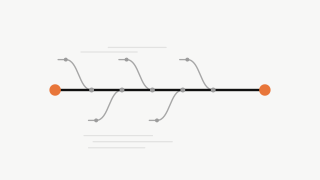
Five Challenges Reshaping Healthcare Revenue Cycle
The Revenue Cycle Management Pressure Shift. | The RCM Pressure Shift
Revenue Cycle Management (RCM) leaders are entering a period in which familiar pressures are converging. A recent Becker's Hospital Review report on healthcare's most dangerous trends captures concerns from health system executives about reimbursement, workforce capacity, payer behavior, artificial intelligence and patient access. For RCM leaders, these are not distant enterprise risks. They show up in clean-claim rates, denials, days in A/R, cost to collect and patient collections.
Five Concerning Trends Reshaping Revenue Cycle Management. | Five Trends Reshaping RCM
1. Reimbursement Is Falling Behind Care Costs.
The financial gap is widening. The American Hospital Association reported that Medicare paid hospitals only 83 cents for every dollar spent on Medicare care in 2023, while hospitals absorbed $130 billion in Medicare and Medicaid underpayments. Its 2026 update also found that hospitals spent $43 billion in 2025 trying to collect payment from insurers for care already delivered. When payment rates lag costs, revenue leakage that once looked tolerable becomes strategically material.
RCM leaders therefore need to protect earned revenue before claims leave the organization. Eligibility, authorization, documentation, coding and charge capture must work as one connected flow. Every preventable correction creates rework, delays cash and consumes capacity that could be used to resolve genuinely complex accounts.
2. Payer Friction Is Becoming Faster And More Automated.
Denials are no longer only a back-end recovery problem. McKinsey reported that 15% of initial claims were denied by the end of 2023, up from 9% in 2016. HFMA has also described payer denials becoming smaller, faster and more sophisticated as automation expands.
The practical response is to move intelligence upstream. Teams should identify recurring root causes by payer, service line, location and workflow step, then convert those findings into front-end edits, documentation prompts and ownership rules. The objective is not simply to appeal more effectively. It is to improve first-pass performance so fewer claims require an appeal at all.
3. Coverage Changes Are Shifting More Risk To Patients.
Coverage disruption, higher deductibles and greater cost sharing are moving more financial responsibility to patients. McKinsey's 2026 healthcare outlook anticipates that Medicaid and Affordable Care Act enrollment changes could increase uncompensated care and reduce provider reimbursement.
That makes patient access a revenue cycle control point. Accurate estimates, timely eligibility checks, financial counseling and convenient payment options can reduce surprises and improve collections. The strongest workflows do not force patients to reconcile conflicting information across scheduling, registration, payer portals and billing. They make the financial journey clear before the balance becomes delinquent.
4. Workforce Constraints Are Exposing Fragile Workflows.
Workforce shortages affect more than staffing expense. They expose processes that rely on tribal knowledge, manual handoffs and individual heroics. McKinsey notes that growing administrative demands stretch scarce revenue cycle resources, while the AHA continues to identify labor as hospitals’ largest expense category.
RCM leaders should standardize work, simplify exception paths and reserve specialized talent for decisions that require judgment. Open accountability is critical here: every handoff needs a named owner, a defined service level and visible evidence of completion. This prevents unresolved work from disappearing between patient access, clinical documentation, coding, billing and follow-up.
5. AI Adoption Is Outpacing Operating Readiness.
AI can accelerate eligibility checks, claim review, work prioritization and appeal preparation. Yet the Becker’s report repeatedly warns against adopting AI without governance, workforce readiness or a clear operating problem. Technology layered onto a broken process can automate inconsistency rather than remove it.
RCM leaders should start with bounded use cases tied to measurable outcomes such as clean-claim rate, authorization turnaround time, denial prevention, productivity or net collections. Human review, auditability and feedback loops should be built into the workflow. The question is not whether a model can produce an output, but whether the operating system can trust, act on and learn from that output.
The Leadership Response Must Connect The Revenue Cycle. | The Leadership Response
These five trends point to one priority: build a revenue cycle that prevents avoidable work, learns across functions and makes performance visible. That requires shared metrics from access through collections, disciplined root-cause correction and clear accountability for the conditions that create denials and delays.
The organizations that respond best will not treat revenue cycle transformation as a collection of isolated projects. They will connect people, process, data and automation around one outcome: getting accurate claims paid correctly and promptly while making the financial experience easier for patients.
A practical starting point is a cross-functional performance review that follows revenue from scheduling to final payment. Instead of reviewing only lagging indicators, leaders can examine where work first becomes incomplete, inaccurate or delayed. That view connects a denial to the missed authorization, documentation gap, coding inconsistency or payer rule that produced it. It also reveals whether automation is removing work or merely moving exceptions to another queue.
The operating cadence matters as much as the dashboard. Weekly root-cause reviews should assign corrective action to the function that can prevent recurrence, while monthly executive reviews should track whether the fix improved first-pass results. This creates open accountability without turning performance management into blame. Leaders can see who owns the next action, what evidence will show completion and whether the intervention produced a durable financial result.
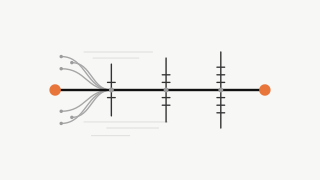
A New Health System CFO’s First 30-60-90 Days
Why A Health System CFO’s First 90 Days Matter. | Why The First 90 Days
A new health system CFO inherits more than financial statements. The role sits at the intersection of strategy, clinical operations, reimbursement, capital, risk and patient access. The transition also begins amid persistent pressure from labor and supply costs, public-payer reimbursement gaps, commercial-payer friction and administrative burden. The American Hospital Association’s 2024 Costs of Caring report reports that labor accounted for about 60% of hospital budgets and increased by more than $42.5 billion between 2021 and 2023, while inflation outpaced Medicare inpatient reimbursement growth.
The first 90 days should therefore produce clarity rather than a long catalog of initiatives. McKinsey’s 2024 research on health-system transformation found that health systems are prioritizing digital and analytics transformation, but many still lack sufficient resources or planning. That gap makes a fact-based assessment of value, readiness and execution capacity essential. For a health system, that fact base must connect enterprise finance to the operating realities that determine whether care is documented, coded, billed and paid correctly.
Use The Learn-Locate-Launch Framework. | The Three-Phase Framework
A simple 30-60-90 day framework keeps the transition focused and gives every phase a tangible output. The progression is deliberately sequential: understand the system before diagnosing it, diagnose it before launching change, and attach every initiative to measurable value, a named owner and a review cadence.
|
DAYS 1-30
LEARN
Understand the system
and establish the baseline |
DAYS 31-60
LOCATE
Find the largest value
gaps and risks |
DAYS 61-90
LAUNCH
Turn priorities into
accountable action |
Days 1-30: Learn The System. | Days 1-30: Learn
The first month is for listening, validation and relationship building. The CFO should align with the CEO and board on strategic priorities, financial expectations, decision rights and the outcomes that will define a successful first year.
The CFO should then assess operating margin, liquidity, debt, cash flow, capital commitments and forecast accuracy while reconciling management reporting, operational data and the general ledger. This validation matters because an improvement plan built on inconsistent definitions creates debate instead of action. The same discipline should be applied to the finance and revenue cycle operating model: leadership depth, staffing, spans of control, decision rights, technology dependencies and external partnerships.
The 30-day output is a shared current-state view. It should state what is known, what still requires validation and which issues may need immediate containment. It is a trusted baseline for action.
Days 31-60: Locate The Value. | Days 31-60: Locate
The second month turns the baseline into a quantified opportunity map. The CFO should examine clean-claim or first-pass acceptance, initial denial rate, net collection rate, days in accounts receivable, aged A/R, discharged-not-final-billed balances, avoidable write-offs and cost to collect. Segment these indicators so enterprise averages do not hide concentrated problems.
The analysis should trace revenue leakage and cash constraints across scheduling, registration, eligibility, authorization, clinical documentation, coding, charge capture, billing, underpayment recovery and collections. The AHA’s 2024 review of hospital financial pressures highlights growing administrative burden from prior authorization, denials and delayed payment. This is why revenue performance must be examined across administrative and clinical functions, rather than treating denials only as a back-end collections problem.
Organizations often spend significant capacity correcting avoidable defects after submission. The AHA’s 2024 Costs of Caring analysis describes the mounting cost of navigating insurer practices that deny or delay access and payment. Operationally, those outcomes should be traced back through registration, eligibility, authorization, documentation and coding. A CFO should therefore quantify not only denied dollars, but also the rework hours, delayed cash and patient friction created when work is not completed correctly the first time.
The review must extend beyond revenue cycle. The CFO should evaluate payer mix, contract performance, reimbursement trends, underpayments and upcoming negotiations; assess labor, contract staffing, purchased services, supplies and pharmaceuticals; and review compliance, cybersecurity, audit findings, revenue recognition, internal controls and business continuity. The 60-day output is a ranked map of value opportunities and enterprise risks, not a disconnected list of departmental complaints.
Days 61-90: Launch Accountable Action. | Days 61-90: Launch
The final month converts diagnosis into an executable first-year roadmap. Each opportunity should pass the 3R Decision Filter: Return, Risk and Readiness. Return asks what measurable financial, operational or patient outcome the initiative will create. Risk considers the consequence of waiting. Readiness tests whether the organization has the leadership capacity, data, technology, funding and cross-functional support to execute successfully.
|
RETURN
What value will it create?
|
RISK
What happens if we wait?
|
READINESS
Can we execute successfully?
|
The CFO should select a small number of early wins that can release cash, reduce preventable rework, address material cost variation or close a visible control gap. An early win could involve resolving a high-value billing hold, correcting an authorization failure pattern or strengthening underpayment recovery. The purpose is to demonstrate repeatable, cross-functional problem solving.
The first-year roadmap should identify quantified outcomes, milestones, dependencies, executive sponsors and directly accountable owners. A CFO dashboard can combine financial results with the operational measures that create them, including first-pass performance, denial prevention, billing timeliness, A/R aging, cash realization and rework volume. Open accountability makes performance visible without turning the dashboard into a blame mechanism: teams can see the standard, the variance, the root cause, the owner and the corrective action in one operating rhythm.
Technology should enter the roadmap only when it improves the operating model. The McKinsey’s 2024 health-system digital investment research shows that many health systems give digital transformation high priority but lack sufficient planning or resources, while Oliver Wyman’s 2024 analysis of hospital headwinds argues that health systems must retool business models and operating strategies around significant reimbursement, cost and capacity pressures. The CFO should therefore fund integrated outcomes, not isolated capabilities.
What Success Looks Like After 90 Days.
By day 90, the CFO should have a credible enterprise financial baseline, a clear view of revenue cycle and cost performance, an agreed set of material risks, several launched early wins and a governed first-year roadmap. Leaders should see where work breaks down and who owns the response.
The framework is simple enough to communicate and rigorous enough to guide decisions: Learn the system. Locate the value. Launch accountable action. Used well, it helps a new health system CFO avoid two common traps: moving before the facts are reliable and studying the organization without converting insight into measurable improvement.
Have a Question for Vee Healthtek?
Vee Healthtek is a practitioner-led, technology-powered revenue cycle partner focused on building resilience through first-pass performance and open accountability. For service inquiries, company information, or questions about our latest announcements, complete the form below. We’ll direct your interest to the right team.
Continue exploring expert perspectives, industry trends, and practical strategies for improving revenue cycle performance.
Explore Points Of View