


Showing items3 of 6

A healthcare provider’s guide to comparing revenue cycle management vendors
Comparing Revenue Cycle Management (RCM) vendors requires more than reviewing service lists, delivery locations or technology claims. Healthcare providers need to determine which RCM companies have the domain expertise, integrated workflows, measurable outcomes, delivery resilience and governance required for their specific operating environment.
This guide brings together a list of RCM service providers assessed by Everest Group and a practical seven-point evaluation framework. Healthcare CFOs and revenue cycle leaders can use it to compare RCM vendors, identify potential partners and build a shortlist based on organizational fit rather than market visibility alone.
What the RCM vendor assessment reveals about the market. | RCM Market Overview
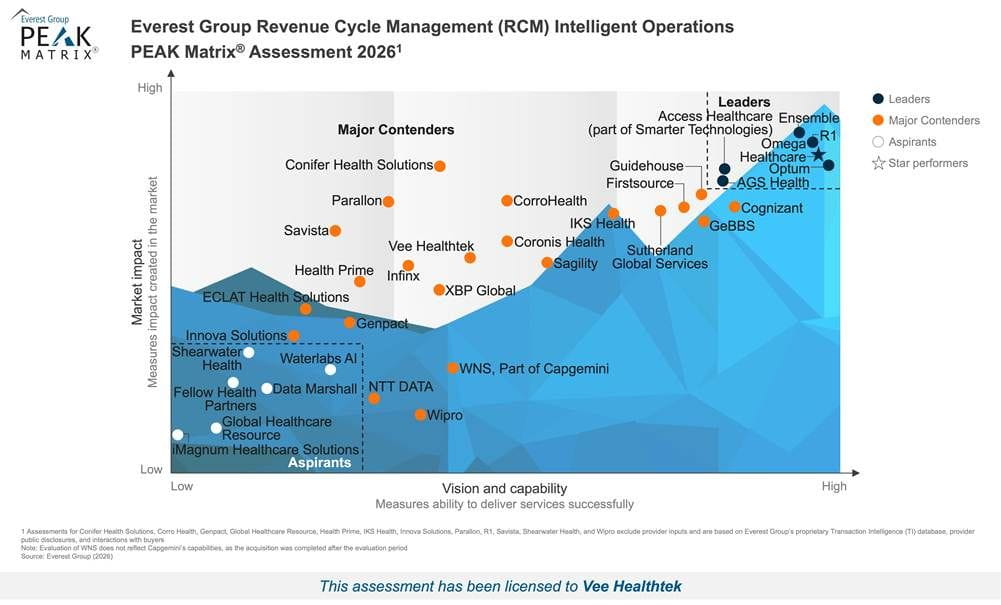
The Everest Group Revenue Cycle Management Intelligent Operations PEAK Matrix Assessment evaluates 34 service providers supporting U.S. healthcare providers. The broader market message is clear: RCM is moving beyond headcount-led outsourcing toward intelligent operating partnerships that combine healthcare expertise, process improvement, automation, analytics and AI.
Margin pressure, labor constraints, reimbursement complexity, fragmented workflows and growing patient financial responsibility are increasing the need for connected execution and measurable financial impact. Healthcare leaders can use the assessment as a starting point for discovering RCM companies before applying organization-specific criteria to build a shortlist.
Revenue cycle management companies to consider when building a shortlist. | RCM Companies Assessed
The assessment includes the following RCM service providers, grouped by their PEAK Matrix position. Healthcare organizations can use this list for initial market discovery before comparing vendors against their specific service, technology, operating and financial requirements.
- Leaders: Access Healthcare, part of Smarter Technologies; AGS Health; Ensemble; Omega Healthcare; Optum; and R1.
- Major Contenders: Cognizant; Conifer Health Solutions; Coronis Health; CorroHealth; ECLAT Health Solutions; Firstsource; GeBBS; Genpact; Guidehouse; Health Prime; IKS Health; Infinx; Innova Solutions; NTT DATA; Parallon; Sagility; Savista; Sutherland Global Services; Vee Healthtek; Wipro; WNS, part of Capgemini; and XBP Global.
- Aspirants: Data Marshall; Fellow Health Partners; Global Healthcare Resource; iMagnum Healthcare Solutions; Shearwater Health; and Waterlabs AI.
The market forces reshaping RCM partnerships. | Market Forces Reshaping RCM
Healthcare providers increasingly need partners that can work across disconnected EHR modules, clearinghouses and payer portals without creating more operational silos. Cybersecurity and AI governance also matter because revenue cycle workflows involve sensitive data and consequential financial decisions. The CMS Interoperability and Prior Authorization Final Rule offers context on information exchange and prior authorization, while the HHS healthcare cybersecurity performance goals provide healthcare-specific practices for cyber resilience.
These challenges are linked. A missed eligibility detail can become a delayed authorization, coding exception, rejected claim and avoidable A/R. Strong patient access management, eligibility and benefits verification and prior authorization help prevent defects early. Clinical documentation integrity, medical coding and revenue integrity help convert care into accurate, supportable claims.
Seven criteria for comparing RCM vendors and building a shortlist. | Seven Criteria For Comparison
- Confirm strategic fit and domain depth. Verify experience across your provider type, specialties, payer mix and priority revenue cycle functions. The proposed model should address your organization’s specific performance gaps rather than force them into a standard service scope.
- Test end-to-end workflow integration. Assess how patient access, documentation, coding, claims, denials and A/R connect across the vendor’s operating model and your existing systems. Look for closed feedback loops that improve first-pass performance by addressing issues before they move downstream and create avoidable rework.
- Validate implementation and delivery resilience. Clarify data, access, interfaces, client resources, transition milestones and escalation paths. Confirm how the vendor will protect cash flow, maintain service continuity and scale through changes in volume, payer requirements or operational priorities.
- Compare measurable outcomes and accountability. Establish baselines for clean-claim performance, preventable denials, cash realization, underpayment recovery, cost to collect and patient experience. Require reporting that connects first-pass performance, rework, root causes, corrective actions and accountable owners to financial impact.
- Evaluate technology and AI in live workflows. Ask where automation, analytics and AI operate, which decisions they support and how their value is measured. Confirm auditability, expert oversight, exception handling, interoperability, PHI protection and security governance.
- Validate evidence and continuous improvement. Request workflow demonstrations, reporting samples, implementation results and references from comparable organizations. Look for evidence that downstream findings drive upstream improvements and prevent recurring defects.
- Examine governance and relationship management. Assess whether reporting provides open accountability by making performance variance, root causes, accountable owners, corrective actions and progress visible. Look for clear account leadership, timely escalation and evidence that recurring issues lead to sustained improvement rather than temporary fixes.
Applying the same seven criteria to every RCM company creates a more consistent and defensible comparison. The strongest shortlist candidates should demonstrate strategic fit and credible evidence that their services, technology, reliable first-pass performance and open accountability for the financial and operational outcomes they commit to improving.
What production-ready AI in RCM should demonstrate. | AI and Technology Readiness
Production-ready AI should improve work prioritization, reduce manual effort and support more consistent decisions inside live revenue cycle workflows. Healthcare providers should examine what data informs each capability, where human review occurs, how exceptions are managed and how financial and operational value is measured.
Interoperability is equally important. AI-enabled execution should connect with EHRs, clearinghouses, payer portals and existing operational systems without creating another isolated work queue. The goal is to scale execution while preserving human judgment, auditability, security and clear responsibility for outcomes.
Vee Healthtek is positioned as a Major Contender in the Everest Group RCM Intelligent Operations PEAK Matrix Assessment. The assessment highlights RevAmp (Vee Healthtek’s RCM Execution Ecosystem), multispecialty billing expertise, certified coding talent, expanded delivery scale and adaptability to changing client requirements. Healthcare providers can evaluate these capabilities using the same seven criteria applied to every RCM company under consideration.

Healthcare CFOs are asking better questions
Healthcare finance leaders are increasingly evaluating revenue cycle performance through a more specific framework: not just whether work is completed, but how their revenue cycle partners’ workforce models influence cost structure, throughput, and margin variability across the health system.
As CFOs and CROs push for more precise explanations of cost to collect changes, productivity variation across solutions, and margin leakage, traditional reporting tools like dashboards, SLA summaries, and retrospective variance analysis are no longer sufficient. It’s not the lens that has changed, but the tolerance for blurry answers.
At a recent Chartered Institute of Global Workforce Management panel featuring leaders from leading revenue cycle solutions companies, one theme around this topic was universally agreed upon: workforce management is being increasingly understood by health system finance leaders as a direct driver of financial outcomes. It no longer asks for a seat at the table. It already showed up and took one.
For CFOs and CROs, this doesn’t mark a reframing of operations, but rather, a reframing of how ROI is actually created inside the revenue cycle, and how much of it is dependent on their partners’ workforce management systems.
Workforce management as a financial control system | Financial control system
Workforce management historically centered on hiring, skill development, and resource management. However, today’s revenue cycle solutions companies see it as a core strategy for structuring work to optimize capacity, task distribution, productivity, and workflows. After all, tracking headcount is straightforward. Managing whether those heads are doing the right tasks, in the right sequence, with the right skills, is where workforce management gets interesting.
Health system CFOs and CROs have taken notice, evaluating their partners’ workforce management models as engines for outcomes at the margin level. As a result, workforce performance is being treated as a determinant of financial predictability rather than a back-office operational metric that remains largely invisible at the executive level.
As CFO expectations evolve, workforce performance is increasingly being judged by its ability to explain margin behavior, not just operational output. - Raghunandan Nagesha, Global Director & Head of Workforce Management, Vee Healthtek
Where financial visibility breaks, and how workforce management defines the fix | Visibility breaks
Most organizations believe they have visibility because they have dashboards. The panel challenged that assumption entirely. The real issue? Data resolution, not data availability. Health system finance teams typically operate with aggregated metrics, including cost per FTE, productivity per team, utilization percentages. These are useful for summaries but insufficient for diagnosis.
High performing revenue cycle partners’ workforce systems operate at a different level entirely. They capture transaction-level effort, task duration, and variance across individuals performing the same work. Without that specificity, root cause analysis becomes speculative. A productivity decline could stem from scheduling inefficiencies, skill mismatches, system friction, or upstream process design. Treating them as interchangeable is a reliable way to fix the wrong problem.
This is where expectations for revenue cycle partners are evolving. The question for health system finance leaders becomes whether performance variance can be explained at the level where it originates before it impacts margin. Without that, every fix looks reasonable until nothing ends up improving.
If capacity cannot be measured at the level of individual tasks and workflows, cost becomes a guessing game. - Chief Revenue Cycle Officer, Southern health system
From retrospective reporting to real-time financial control | Real-time control
A consistent theme across the workforce management leaders was the gap between reporting performance and actively managing it. Traditional reporting cycles introduce lag. By the time results are reviewed, the operational window to correct them has already closed. Then, the reporting is less like insight and more like regret.
Real-time deviation tracking is allowing revenue cycle companies to adjust staffing, shift workloads, and correct process bottlenecks while work is still in motion. That changes the nature of control from observational to active. In practice, this looks like live workload balancing across teams based on incoming volume, immediate reassignment of work queues when productivity dips below threshold, and dynamic staffing adjustments during the day rather than after close.
For finance leaders, revenue cycle partners’ workforce management sophistication is now tied to a health system’s financial predictability. Outcomes are governed within the revenue cycle, not alongside it, because workforce management directly determines whether cost, throughput, and margin behave as designed or drift under operational variability. What looks like operational detail is where financial performance is determined.
Real-time workforce control is becoming the baseline expectation. That’s changing how revenue cycle solutions companies are judged on financial outcomes. - Raghunandan Nagesha, Global Director & Head of Workforce Management, Vee Healthtek
Reporting doesn’t move margins, workforce management does | Margins
The room was in agreement: workforce management is no longer being evaluated as an operational function in isolation, but as a key part of how financial outcomes are produced, measured, and controlled.
If workforce performance cannot be consistently measured by revenue cycle companies at a granular level, financial performance loses predictability. And if interventions cannot occur in real time, margin protection turns reactive.
For CFOs and CROs, this is a fundamental reframing of how financial resilience is actually created inside the revenue cycle. Workforce management sits inside that system, not alongside it, because it directly determines whether cost, throughput, and margin behave as designed or drift under operational variability.
When workforce management is aligned with financial objectives, measured at the right granularity, and benchmarked consistently across delivery models, it becomes a system that determines, not predicts, financial performance.
AI Investments That Deliver
The debate is over. The question is no longer whether AI belongs in healthcare, but how quickly organizations can turn its potential into performance. Now, the primary challenge for CFOs is prioritizing AI investments that deliver measurable ROI and scale under governance.
IAOP’s AI and Healthcare: What’s Real and What’s Hype webinar brought together leading voices across healthcare, technology, law, and strategy to follow this shift from AI as a concept to AI as a driver of revenue. From early failures to financial gains, here’s what health system finance leaders need to know.
AI in Healthcare: What’s Real, What’s Hype | Michelle Castillon | IAOP Virtual Panel Vee Healthtek Watch on
The acceleration isn’t slowing down. It’s compounding. | Acceleration is compounding
A year ago, AI in revenue cycle was a promising bet. Today, it’s a corporate asset. Michelle Castillon, Chief Product Transformation Officer, has watched this shift firsthand: while early AI coding solutions stalled at 40-50% accuracy, today’s solutions are reaching 95%+ within 90 days, accelerating cash flow, reducing leakage, and improving net revenue realization. From coin flip to near certainty in one product cycle.
The implication is clear: what was once emerging technology is now delivering enterprise-grade financial impact. AI has become an engine for margin improvement and cash acceleration, but only when paired with disciplined execution.
Investing in high-yield AI | High-yield AI
The difference between AI that has been deployed and AI that is delivering is stark. For finance leaders, this distinction separates sunk cost from realized return. The wins worth CFO attention fall into a few categories:
- Work queue intelligence: Predictive modeling outputs embedded directly into revenue cycle workflow tools enable automatic inventory prioritization based on collectability, denial risk, and account complexity. The process becomes scalable without reliance on institutional memory or ad hoc decision-making.
- Appeals and denial management: Historically, generating clinical and technical appeal responses has been one of the most time-intensive functions in revenue cycle. That is changing fast. Access to richer clinical and coding data, combined with large language models trained on payer policy and contract terms, has made auto-generated appeal responses increasingly viable.
- The payer value chain: Payer organizations are among the most aggressive AI adopters, applying it across product management, underwriting, care management, pharmacy benefits, claims adjudication, and customer service.
The gap between insight and execution | Insight to execution
A generation of ambitious AI pilots taught the healthcare industry a valuable lesson: deploying technology and deploying it well are entirely different challenges. Early implementation fell short not because the tools were immature, but because outputs were divorced from the people and processes that mattered. Dashboards generated insights that went unused, alerts that were dismissed, and recommendations that never translated into action.
The leaders seeing real results are those that seamlessly weave AI into workflows, so the technology functions not a separate layer of analysis but as part of the organizational fabric itself. This way, intelligence is connected directly to execution. The lesson here is operational: Insight is easy. Integration is where the rubber meets the road.
Security risks can sink ROI | Security risks
As digital access expands from humans to autonomous agents, the number of entry points for malicious actors increases. In healthcare, that risk is magnified. Each system vulnerability puts patient safety, data privacy, and clinical outcomes at risk.
As organizations adopt AI agents, it increases the surface area for cyberattacks.
Jessica Pan, Global Outreach, SandboxAQ
For CFOs, these risks carry direct financial consequences, including regulatory penalties and reputational damage. The solution is not to retreat from AI, but to deploy it with the same level of sophistication leveraged by attackers.
Health systems that build proactive security posture into AI governance will be in a fundamentally different position than those that treat it as an afterthought. Risk-adjusted ROI will increasingly separate successful AI adopters from the rest.
The bots are ready. The question is whether the org chart is, too.
Managing risk, maximizing return | Risk and return
AI progress is only sustainable with robust governance infrastructure. More tools without more discipline means more chaos. Successful AI adoption requires honest communication about what changes and what stays the same. Organizations that address and clarify uncertainty see new technologies embraced.
Creating dedicated AI governance teams, rather than shoehorning oversight into existing IT committees, is critical. Each deployment decision should carry clear answers from the AI governance team. Who owns this? Who audits this? What are the KPIs? If the answer to any of those is “great question,” start over.
The multi-supplier problem reinforces this point. When AI is launched by multiple vendors, organizations must own the outcomes across the whole ecosystem. Centralized ownership ensures leaders maintain visibility into performance. Without that, the ROI crumbles.
It really does take a true investment from an organization to change the culture and manage change and training - Michelle Castillon, Chief Product Transformation Officer, Vee Healthtek
The bottom line for finance leaders | Bottom line
The health systems leading the way with AI are not those that have deployed the most tools or chased AI in the abstract. True value comes to those who combine bold experimentation with intentional strategy.
Those realizing measurable impact were deliberate from day one: integrating AI into workflows, establishing well-defined governance protocols, and aligning technology with business outcomes. They learned from their mistakes, turning setbacks into a competitive advantage. They now understand that AI’s potential is not measured by the number of automated systems or workflows but by how AI is embedded, measured, and scaled.

CMS-0057-F Prior Authorization Automation
CMS 0057 F is more than a compliance deadline - it's a forcing function to redesign prior authorization as a measurable, governable production system. This playbook shows U.S. Health System CFOs and Revenue Cycle leaders how FHIR based exchange, disciplined intake and documentation, and observability reduce avoidable delay, touches, reschedules, and denials. Follow a pragmatic 12-18 month roadmap to convert authorization friction into cash, capacity, and patient trust today.
If you're a Chief Financial Officer (CFO) or a Senior Vice President (SVP) of Revenue Cycle Management (RCM) at a U.S. health system, you already know prior authorization isn't a policy debate, it's an operating reality. It sits right where access, clinical documentation, payer friction, patient expectations, and cash flow collide.
The CMS-0057-F, formally, the Centers for Medicare & Medicaid Services (CMS) Interoperability and Prior Authorization Final Rule, is often described as a rule about speeding up prior authorization. That description is directionally true, but incomplete. In practice, CMS-0057-F is a forcing function: it pushes the industry toward measurable, auditable, digital exchange of authorization information, aligned with the broader direction described under CMS Interoperability. And once authorization becomes more standardized and observable, the old phone/fax heroics model becomes harder to sustain.
This is not just about compliance. It's about your cash conversion cycle, your capacity utilization, your denial risk, and, quietly but materially, your patient leakage. The health systems that treat CMS-0057-F as a checkbox will digitize friction. The ones that treat it as an operating model redesign will turn prior authorization (Prior Authorization) into something the finance team can actually manage: predictable throughput with fewer surprises.
I'm writing this for leaders who don't need another generic "automation is good" article. You need a CFO-grade view of what changes operationally, technically, financially, and strategically, and how to execute without breaking everything else along the way.
What CMS‑0057‑F is really doing (and why the "it's a payer IT project" story is wrong) rich | What the rule really does
Let's start with the misconception I hear most often: "This is a payer rule. They'll build the interfaces. We'll connect. Done."
If it were that simple, prior authorization would already be solved.
CMS-0057-F sits inside a larger federal direction toward interoperability, the ability of systems to exchange information reliably and in standardized ways, captured broadly under CMS Interoperability. The rule is widely discussed as encouraging movement away from manual exchange and toward modern standards-based data exchange, commonly associated with HL7 FHIR, Health Level Seven (HL7) Fast Healthcare Interoperability Resources (FHIR). And that FHIR-based direction matters, but not in the way most people think.
Here's what's actually happening when you shift authorization from manual channels to structured digital exchange:
- Visibility increases. Cycle time, pend reasons, decision patterns, and handoff delays become measurable.
- Variation gets punished. Inconsistent documentation and missing data don't just slow you down, they create pends and denials faster.
- Workflow design becomes destiny. When exchange is automated, the system amplifies your process quality. If your process is weak, automation scales weakness.
So yes, there's a technical layer. But the true transformation is operational and financial: the rule pushes authorization into a world where it behaves more like an engineered production process than an artisanal back-office function.
For CFOs and Revenue Cycle SVPs, that means one thing: prior authorization becomes governable, but only if you design it that way.
Why CFOs should care: prior authorization is a working capital constraint disguised as admin work | Why CFOs should care
In most health systems, the financial impact of prior authorization is fragmented across departments and dashboards. It doesn't show up neatly as Authorization Cost on a P&L. It shows up as:
- delayed scheduling and reschedules,
- underutilized clinical capacity,
- denials tied to missing or invalid authorization,
- staff rework and status chasing,
- slower cash, higher days in accounts receivable (A/R),
- and patient leakage when waiting on the payer becomes the patient's experience of your brand.
That's why the real CFO frame is not how do we automate Prior Authorization? It's:
How do we reduce uncertainty upstream so revenue downstream becomes predictable?
When authorization timing is uncertain, everything that depends on it becomes uncertain: scheduling, staffing, operating room block utilization, imaging throughput, specialty drug starts, infusion chair utilization, and claim timing. This is why prior authorization is not simply an Revenue Cycle task, it is a capacity and cash conversion system.
The strongest financial indicator I've found isn't how many faxes did we eliminate. It's this:
Avoidable delay per authorization: the portion of cycle time that is caused by preventable workflow issues (missing documentation, wrong routing, unclear ownership, repetitive follow-up loops).
Reduce avoidable delay, and you don't just save labor, you protect revenue, reduce denials, stabilize capacity utilization, and compress cash cycles.
And if you want a sober governance lens, finance leaders often align on operational performance frameworks through communities like the Healthcare Financial Management Association (HFMA). Prior authorization modernization belongs in that class of work: a revenue-critical constraint you can measure, manage, and continuously improve.
Prior authorization doesn't break in the middle, it breaks at the edges | Where it breaks
When people describe their authorization problems, they often blame payers, portals, or staffing. Those can be real issues. But when you do a case-level walkthrough, most failures happen at the edges:
This is why automation projects fail when they start with connectivity instead of workflow truth. If you digitize a weak intake process, you just move incomplete submissions faster, and get pends faster. If you digitize inconsistent documentation, you get denials faster.
The hard part isn't speed. The hard part is correctness at scale.
What FHIR-based really means for CFOs and Revenue Cycle SVPs: data discipline, not interfaces | What FHIR really means
Let's demystify the technical piece without turning this into an IT whitepaper.
FHIR (Fast Healthcare Interoperability Resources) is a modern HL7 standard designed to exchange healthcare information via application programming interfaces (APIs), the core specification lives at HL7 FHIR. FHIR matters because it enables standardized, more automated data exchange between systems.
But FHIR is not magic. FHIR does not fix your documentation. It does not solve payer policy variation. It does not redesign your workflow.
What it does do is expose a reality CFOs should care about:
Structured exchange rewards structured operations.
If your electronic health record (EHR) workflow doesn't reliably capture required authorization data, a FHIR-based exchange will still fail, just more efficiently. The underlying discipline required, data governance, standardization, workflow design, is closely aligned with interoperability priorities long advanced by the Office of the National Coordinator for Health Information Technology (ONC).
So when someone says, "We need to be FHIR-ready," the CFO and Revenue Cycle SVP translation should be:
- Are our intake workflows capturing the right data elements at the point of origin?
- Are our documentation templates aligned to payer requirements for the top service lines?
- Do we have governance to control changes, track exceptions, and manage payer variability?
- Can we measure cycle time, touches, and exception patterns end-to-end?
FHIR is the highway. Your workflow and data quality are the vehicle. If the vehicle is unreliable, a faster highway doesn't help.
The operating model shift: from heroic work to an engineered production system | The operating model shift
Every health system I've seen that gets prior authorization right eventually makes the same mental shift:
Stop treating authorization as a series of tasks. Start treating it as a managed production system.
That means building an operating model with:
- clear ownership,
- predictable routing,
- standard inputs,
- quality gates,
- measurable SLAs,
- and explicit exception handling.
In plain terms: you need a centralized Prior Authorization command center, a function designed like a control tower.
What a centralized Prior Authorization command center changes
- Single accountability: cases don't float between teams.
- Prioritization by reality: work is ordered by appointment date, clinical urgency, and dollars at risk, not by who shouted last.
- Standardized playbooks: the team knows what complete means for high-volume procedures.
- Closed-loop learning: pends and denials inform workflow and documentation changes, not just more follow-up.
- Instrumented performance: cycle time and touch count are measured like production metrics.
This is the moment where Revenue Cycle leadership evolves. In an API-driven, timebound world, the Revenue Cycle SVP becomes a flow architect and a data governor, not simply the owner of a back-office process. That's a strategic change in how revenue cycle leaders create value.
And it's also where differentiation happens. A lot of the market talks about scale in Revenue Cycle. But scale without redesign often means you're simply processing more exceptions.
The durable advantage comes from reducing exceptions, not building bigger factories to handle them.
A candid sidebar: the three failure modes I keep seeing | Three failure modes
This is the part most vendor content avoids, because it's uncomfortable. But it's also where CFOs and Revenue Cycle SVPs live.
Failure mode #1
Automating submission without fixing intake
Teams implement automation, but orders still enter the pipeline without required data. The automation submits anyway. Pends increase. Touches increase. The organization concludes automation didn't work, when what failed was the front-end design.
How to spot it: First-pass approval rate drops after automation go-live.
Failure mode #2
Treating documentation as a provider problem instead of a system problem
Organizations assume clinicians will document better without redesigning templates, clinical workflows, or data capture prompts. Then they wonder why pends persist.
How to spot it: Pend reasons cluster around need more clinical information and repeat across sites.
Failure mode #3
Building connectivity without observability
Interfaces go live, but there is no true audit trail: what was sent, when, what changed, and why. Exceptions are invisible. Compliance risk increases while confidence decreases.
How to spot it: Leadership can't answer basic questions during an escalation: "Where is this case stuck and who owns it?"
These failure modes aren't about effort. They're about design. And design is fixable, if you treat Prior Authorization as a system.
The technology architecture that scales (and the architectural mistakes that don't) | Architecture that scales
You can modernize prior authorization and still end up with an unmanageable mess if the architecture doesn't scale.
The most common mistakes I see:
- Point integrations that don't scale across payers or service lines
- Treating authorization as a silo rather than integrating it with scheduling and claims
- Weak master data management (provider identifiers, locations, service codes)
- Lack of observability (audit trails, case tracking, performance analytics)
- Heavy payer-by-payer customization that creates technical debt
A scalable architecture has three characteristics:
Where Artificial Intelligence actually helps, and where it becomes expensive theater | Where AI actually helps
Artificial Intelligence (AI) and Machine Learning (ML) can create real value in prior authorization, but only when applied to reduce rework and touches per case.
Any AI used in the authorization process should be governed with an explicit risk posture consistent with frameworks like NIST AI. For CFOs, the key financial question is simple:
Does AI reduce touches and cycle time without increasing denials or audit exposure?
If it doesn't, it's not transformation, it's cost
Payer-provider dynamics: interoperability must be operationally reliable, not just connected | Payer - provider dynamics
Interoperability without operational reliability becomes a burden shift.
If digital exchange becomes more standardized, then response timing, pend patterns, and decision rationale become measurable. That's where CFOs and Revenue Cycle SVPs should push the conversation beyond "we have an interface."
Providers should demand:
- stable and well-documented APIs,
- actionable pend and denial reason codes,
- transparent status updates,
- predictable change communication cadence,
- and realistic testing pathways.
And internally, this is where payer scorecards become useful, not for politics, but for operational governance. The point isn't to win an argument with a payer. The point is to manage the constraint like any other production dependency.
Speed without fragility: compliance, defensibility, and audit posture | Speed without fragility
The fastest organizations are not the ones that cut corners. They're the ones that reduce variation.
As authorization becomes more measurable and time-bound, the risks that matter are:
- incomplete audit trails,
- inconsistent data exchange,
- unmanaged exceptions,
- and documentation variability that increases denial and audit vulnerability.
This is where information governance matters, disciplines often associated with organizations like AHIMA. It's also why many leaders keep a broader compliance posture in mind; defensibility is strengthened when your process is traceable and controlled, values reinforced in oversight contexts such as HHS OIG.
You don't need to become paranoid. You need to become deliberate: quality gates, traceability, and disciplined exception management.
A pragmatic 12–18 month roadmap for CFOs and Revenue Cycle SVPs | The 12–18 month roadmap
This roadmap assumes a centralized Prior Authorization command center model and prioritizes controllable wins over heroic scope.
Months 0-3
Baseline, map, and choose where to start
- Baseline: cycle time, touches per case, first-pass approvals, pend reason mix, auth-related denials
- Map current-state workflow end-to-end, including scheduling dependencies
- Select 1–2 high-value service lines first (high volume, high margin, high denial risk)
- Establish governance with authority across clinical operations, Revenue Cycle, IT, and compliance
Months 3-6
Fix the front end and build quality gates
- Standardize intake workflows and documentation templates
- Implement submission completeness checks (quality gates)
- Define work queues, ownership, escalation logic
- Pilot digital exchange where feasible; document every step
Months 6-12
Scale connectivity and operationalize automation
- Expand payer connectivity and status automation
- Integrate Prior Authorization workflow into scheduling and claims (stop treating it as a silo)
- Build observability dashboards: cycle time, touches, exception aging, dollars at risk
- Introduce AI carefully for completeness and prioritization only after data discipline is stable
Months 12-18
Institutionalize continuous improvement
- Expand to additional service lines and sites
- Reduce exceptions by changing upstream templates and workflows
- Formalize playbooks and a governance cadence
- Tie outcomes to cash conversion and denial reduction, not just operational activity
This is how you turn CMS-0057-F from a mandate into a competitive capability.
The future of Revenue Cycle: front-end certainty becomes the new differentiator | The future of Revenue Cycle
Revenue Cycle is moving from back-end salvage to front-end certainty.
In value-based and consumer-driven care, authorization delays are not just administrative friction, they impact outcomes, satisfaction, and network loyalty. CMS-0057-F accelerates the shift to authorization as a digital, measurable service integrated into care delivery.
The winners will be the systems that build:
- predictable authorization throughput,
- low-variation documentation,
- disciplined exception management,
- and observability that supports operational control and defensibility.
That combination doesn't just reduce cost. It stabilizes revenue and protects capacity. For CFOs and Revenue Cycle SVPs, that is the real prize.
A CFO scorecard | A CFO Scorecard
How to use this: Run this in a weekly Prior Authorization Command Center operating review and a monthly CFO/Revenue Cycle SVP review. Keep the list stable; trend matters more than perfection.
Closing: The strategic choice CMS‑0057‑F forces | Closing
CMS-0057-F is a compliance event, but it's also a strategy moment. It pushes prior authorization toward standardized digital exchange and measurability. For CFOs and Revenue Cycle SVPs, that is an opportunity, if you treat Prior Authorization as a production constraint you can redesign and govern.
If you do this right, you'll see fewer denials, fewer reschedules, lower rework, faster access, and more predictable cash. Not because you automated prior authorization, but because you engineered an operating model that produces predictable outcomes.
CMS‑0057‑F Glossary
- CMS‑0057‑F: CMS Interoperability and Prior Authorization Final Rule; widely discussed as advancing standardized digital exchange and measurability in prior authorization.
- CMS (Centers for Medicare & Medicaid Services): Federal agency driving interoperability policy.
- Prior Authorization (Prior Authorization): Payer approval required before certain services; affects access, scheduling, denials, and cash.
- CFO (Chief Financial Officer): Executive owner of financial performance, cash, and risk.
- RCM (Revenue Cycle Management): End-to-end billing and collection operations including eligibility, authorization, claims, and denials.
- A/R (Accounts Receivable): Money owed for services rendered; Prior Authorization delays can increase A/R days.
- HL7 (Health Level Seven): Standards body; publishes FHIR.
- FHIR (Fast Healthcare Interoperability Resources): API-based healthcare data exchange standard.
- API (Application Programming Interface): Software interface enabling systems to communicate; core to modern interoperability.
- EHR (Electronic Health Record): System of record for clinical data; workflow design determines Prior Authorization readiness.
- SLA (Service-Level Agreement): Defined performance expectation for turnaround times and escalation.
- AI (Artificial Intelligence) / ML (Machine Learning): Techniques that can reduce rework by predicting missing documentation and prioritizing queues.
- ONC (Office of the National Coordinator for Health Information Technology): Interoperability context and standards alignment.
- OIG (Office of Inspector General): Oversight context; defensibility benefits from traceability.
- AHIMA: Information governance and documentation discipline context.
- Touches per Authorization: Count of human interactions per Prior Authorization case; best proxy for true operational cost.
- Observability: Ability to trace workflow events (what happened, when, why); key for control and defensibility.
The Medicaid supplemental payment cliff
If your health system relies on Medicaid supplemental funding - directed payments through managed care, rate enhancements, or settlement-driven uplift - the One Big Beautiful Bill Act (OBBBA) introduces a real risk: a Medicaid supplemental payment cliff. In simple terms, when federal rules tighten around Medicaid provider taxes and state-directed payments (SDPs), states can have less flexibility to sustain supplemental payment capacity. The result is often not a single-day cut, but a phased squeeze that shows up as settlement variance, cash timing slippage, or net Medicaid revenue compression.
What is the Medicaid supplemental payment cliff? | What is the cliff?
It is the risk that Medicaid 'uplift' shrinks because the financing mechanics behind it tighten. The Medicaid supplemental payment cliff is not a single program. It's a financial condition: supplemental Medicaid dollars that support hospital payments can compress when the state's financing levers narrow. In many states, provider taxes and SDPs materially influence Medicaid payment capacity. When those levers are constrained, the impact can appear as a lower reconciliation, reduced directed payment levels, or slower cash realization, even if your core billing operations remain strong.
Why OBBBA makes this a CFO issue | Why OBBBA matters
The law's scale and the specific financing provisions make supplementals worth board-level attention. In the Congressional Research Service (CRS) summary of OBBBA's health coverage provisions, CBO estimates indicate federal outlays would be reduced by $907.5B over FY2025-FY2034, with Medicaid provisions accounting for $840.2B. CRS also reflects a CBO estimate of 9.1M more uninsured people in FY2034 from the health coverage provisions summarized, including 7.8M from the Medicaid provisions. Even if your market impact differs, the direction is clear: states will operate Medicaid programs under tighter constraints while health systems face higher volatility in payer mix and collections.
CRS also describes administrative changes that can increase churn, for example, eligibility redeterminations every six months for ACA expansion adults beginning December 31, 2026 (with an associated outlay reduction of $63.817B shown in the CRS table). This matters because churn and supplementals can move in the wrong direction at the same time: more eligibility friction can increase self-pay exposure just as Medicaid uplift tightens.
How provider taxes and State-Directed Payments (SDPs) show up in cash | How it shows up in cash
The risk shows up as settlement variance, underpayments, and timing issues; not just a rate line item. Most systems don't 'lose' supplementals on a Tuesday. They discover the problem when expected directed payments don't reconcile, settlement timing shifts, or underpayments age beyond what teams can recover. That's why CFOs should treat the supplemental payment cliff like a credit event: you need traceability from contract terms to claim logic to reconciliation to cash posting. If any link in that chain is opaque, you're exposed
How to quantify exposure in 14 days | Quantify exposure in 14 days
These five steps produce a finance-grade baseline you can defend.
- Inventory every Medicaid uplift stream (directed payments, rate enhancements, settlements) and tag each as provider-tax dependent, SDP dependent, or other.
- For each stream, capture: owner, contract or approval reference, where it hits net patient service revenue and cash, and reconciliation timing.
- Pick one high-dollar stream and trace it end-to-end: contract → claims → reconciliation → cash posting. Document failure points.
- Build three scenarios (Base / Constrained / Highly Constrained) and quantify EBITDA-at-risk and cash impact by quarter.
- Publish a one-page scorecard: top three exposure drivers, top three operational fixes, and the next decision date.
A 90-Day margin protection blueprint | The 90-day blueprint
- This is an operator plan to reduce variance while you still have time.
- Days 1-30 is visibility: complete the inventory, run scenarios, and align on the exposure scorecard.
- Days 31-60 is execution: fix the top leakage sources that worsen when supplementals tighten - denials, underpayments, and posting issues.
- Days 61-90 is governance: establish a lightweight 'Medicaid Margin Office' cadence to update assumptions, monitor reconciliation variance, and track recoveries.
Metrics that reveal risk early | Metrics that reveal risk
Watch these indicators weekly so issues surface before settlement season.
| Risk Signal | Metrics to Watch | Immediate Action |
|---|---|---|
| Directed payment variance | Expected vs paid by program; settlement delta | Validate contract terms; reconcile monthly; open underpayment cases |
| Cash timing slippage | DSO by Medicaid MCO; cash posting latency | Fix remittance mapping; accelerate follow-up; tighten posting rules |
| Denials spike | Denial rate and top denial reasons | Root-cause top 3 codes; update edits/workflows; retrain |
| Underpayment leakage | Recovery rate and aging of underpayment cases | Automate detection; assign worklists; escalate to payer |
| Payer mix churn | Self-pay share; churn indicators tied to redeterminations | Strengthen front-end verification; financial clearance; charity workflows |
Decision checklist: Are we exposed? | Decision checklist
If you can’t check at least four, treat this as urgent.
- We can list every Medicaid supplemental stream and the dollars tied to each. We can trace at least one SDP/directed payment from contract to cash posting.
- We can produce a quarterly EBITDA and cash sensitivity view within 48 hours.
- We run weekly worklists for Medicaid denials and underpayments (not monthly surprises).
- We have a named owner for Medicaid managed care contract readiness and settlement monitoring.
Core thesis | Core thesis
- OBBBA tightens Medicaid financing mechanics; when provider taxes and SDPs tighten, supplemental Medicaid uplift can compress over time.
- The near-term CFO risk is unmodeled dependence on provider tax/SDP-driven supplementals that hits settlements and cash timing.
- The practical fix is operational: map every supplemental stream, run scenarios, and harden revenue integrity so surprises become managed variance.
How we can help | How we can help
Vee Healthtek is a service-led, technology-powered Revenue Cycle partner focused on measurable outcomes. We help health systems (1) quantify Medicaid net-revenue exposure by building a finance-grade view of supplemental streams and operational drivers, (2) protect cash through revenue integrity, denial reduction, and underpayment recovery execution, and (3) operationalize a 'Medicaid Margin Office' cadence with dashboards, worklists, and accountability - so policy changes translate into timely actions.

From Rollout to Results
Walk into enough healthcare finance conferences and you start to recognize the room. The HFMA Metropolitan New York 66th Annual Institute felt different. The conversations were sharper, the skepticism was healthy, and the people had been around long enough to separate what sounds good from what actually works.
This kind of trial-by-fire perspective sets the tone for how these leaders approach change. Healthcare finance isn’t waiting for a breakthrough moment. It’s building one carefully, deliberately, and yes, occasionally stubbornly. The charge is being led by CFOs who demand ROI before they sign off, revenue cycle leaders who won’t deploy a tool their teams don’t understand, and operational leaders who know that denial rates don’t lie. They understand that hype doesn’t move the needle, no matter how shiny the slide deck is.
For healthcare CFOs and revenue cycle leaders, this is where AI in healthcare revenue cycle meets real-world execution.
No transformation theater. Just execution | Execution over theater
The common thread across sessions, panels, and hallway conversations was clear: healthcare leaders are not chasing flashy transformation nor resisting change. They’re focused on disciplined execution.
There was a consistent recognition that sustainable progress depends on bringing people along, not just rolling tools out. The organizations gaining ground are the ones where staff feel equipped, where accountability is shared, and where the humans in the loop are treated as a feature, not a fallback. The organizations struggling? They built the humans in as the break-glass option. And then spent a lot of time breaking glass.
Three priorities, one system | Three priorities
Separately, financial stability, operational excellence, and AI-driven automation are familiar priorities. Together, they define the future of revenue cycle management. Denials, cash flow, and cost-to-collect are no longer isolated metrics, but downstream results of upstream discipline.
To put it simply: fix the front, fuel the back. Patient access and front-end Revenue Cycle directly influence outcomes. But behind every eligibility check, prior authorization, and point-of-service collection is a person navigating a system that is often fragmented and under pressure. When the front end breaks down, it’s not just a data problem. It’s a staff problem, a patient experience problem, and, eventually, a revenue problem.
When the front end is fragmented, the back end is where the consequences show up - Chief Revenue Cycle Officer, Midwest health system
Small shifts, big impact | Small shifts
One of the most grounded perspectives came from Ford Koles, who emphasized that transformation in AI adoption in healthcare is rarely dramatic; it’s cumulative. Less “Big Bang” and more “slow burn.”
Operations are quietly being reshaped by labor constraints, market shifts, closures, and changing populations. These pressures don’t call for a wholesale reinvention, but for smarter tools layered into existing workflows. And Koles was clear that the organizations getting this right are the ones where staff actually trust the tools they’re using, where implementation was done with them rather than to them, and where the measure of success is whether the work got better, not just faster.
The future is human-led and data-driven | Human-led future
Revenue cycle management is no longer just operational. It’s strategic. The organizations leading this shift understand that technology is only as effective as the people guiding it and the culture supporting it. “We rolled it out” and “we actually use it” are not the same milestone.
The future belongs to the leaders who balance automation with accountability, efficiency with empathy, and innovation with intention. That means investing not just in the right tools, but in training, change management, and building staff confidence so that humans and AI can do their best work together. AI can’t shine if it’s treated like a magic 8-ball.
If your staff doesn’t trust the tool, you don’t have adoption. You have decoration. - CFO, Northeast hospital
Denials, dollars, and discipline | Denials and discipline
The room didn’t leave empty-handed. Here’s what traveled home in the CFOs’ briefcases:
Front-End First: Strong denial prevention strategies start upstream, because fixing the problem later is always more expensive. The people and tools managing these touchpoints are your first line of defense.
Focus on workflows, not tools: Identify friction, then apply AI in revenue cycle where it matters. Otherwise, it’s just another tool everyone nods at and nobody uses.
Measure What Matters: Tie AI to outcomes, such as denial rates, days in A/R, cost-to-collect, and productivity. If it doesn’t move a metric, it doesn’t move the business.
How Vee Healthtek helps: precision in practice | How Vee Healthtek helps
The organizations that outperform aren’t the ones deploying the most AI; they’re the ones applying AI with discipline. That’s how denials go down, revenue goes up, and trust stays intact.
It’s a standard Vee Healthtek holds itself to, as well. What we build is precise, yet practical, because discipline without usability doesn’t stick. Our teams work alongside yours, learning your processes, understanding your challenges, and making sure the tools we deploy take root and perform. Because the goal was never AI or automation for its own sake. It was better outcomes, stronger performance, and a revenue cycle you can stand behind.

Stop Sprinkling AI
The legacy playbook for AI in revenue cycle is still to deploy broad Large Language Models (LLMs) across the workflow. In production, that strategy creates two avoidable risks: dependency on a single model roadmap and rapid obsolescence, especially once you factor in Protected Health Information (PHI) handling and payer-specific rule nuance.
This paper proposes a more durable execution architecture built around Task Specialized Models (TSMs): a portfolio of models designed to do a bounded set of Revenue Cycle Management (RCM) tasks exceptionally well, with structured outputs, explicit evaluation scorecards, and tight feedback loops. TSMs are paired with a control layer that governs minimum necessary data exposure, policy grounding, confidence thresholds, escalation, auditability, and quality oversight - so execution becomes reliable, repeatable, and safe to scale across high volume workflows.
The practical outcome is not “AI as a sidecar.” It is a governed execution layer that turns the daily language of revenue cycle work - eligibility text, edits, denials, payer letters, A/R notes - into structured operational action that can be routed, measured, and improved over time.
A production point of view: revenue cycle rewards execution, not general intelligence | Production point of view
In revenue cycle operations, the limiting factor is rarely a lack of insight. Most organizations already know where the friction is. The real constraint is the cost and inconsistency of turning that insight into the next operational step - reliably, repeatedly, at volume.
Every day, revenue cycle teams translate semi structured inputs into work artifacts: eligibility responses become next steps; claim edits become correction plans; denial codes become standardized work instructions; payer letters become evidence checklists and appeal narratives; remittance lines become recovery paths. These are not open-ended reasoning exercises. They are bounded execution tasks that must be carried out under policy constraints, within workflow handoffs, and at industrial scale.
That framing matters because it changes what “good AI” looks like. In production Revenue Cycle, the right question is not “Can the model answer anything?” It is “Can the system execute the right next action consistently, at predictable cost, with traceable evidence?”
Why “LLM everywhere” becomes fragile in production | Why LLM everywhere is fragile
The issue with LLMs is not usefulness - LLMs can be valuable for synthesis and exceptions. The fragility comes from an architectural mismatch when a single broad model is used as the default engine for high volume execution.
First, “one model everywhere” increases operational dependence on a single model family and roadmap. When model behavior shifts (because of upgrades, tuning, or vendor-side changes), that behavior change propagates across the workflow. In an environment where consistency is a first order requirement, this is systemic risk, not an inconvenience.
Second, the shape of Revenue Cycle work is bounded: it expects structured outputs, stable templates, clear gates, and auditable provenance. The more you push a general model into bounded execution, the more you end up rebuilding constraints and control logic around it anyway - without the tight feedback loops that make improvement fast and measurable.
A better approach is to stop treating AI as a single monolith and start treating it like production software: a portfolio of specialized components with explicit contracts (schemas), explicit gates, and explicit measurement.
What a Task Specialized Model is in the operating context | What a TSM is
A Task Specialized Model (TSM) is a model designed for a defined operating context and evaluated against the exact shape of the task it must perform. In Revenue Cycle, that often means one model for eligibility interpretation, another for claim edit explanation, another for denial categorization, another for appeal assembly, and another for A/R next step recommendation. These tasks share a domain, but they do not share identical inputs, outputs, or governance needs - so they should not share identical model behavior.
A simple operational constraint makes TSMs practical: use deterministic logic whenever it can safely decide and invoke a TSM only when the workflow encounters ambiguity that can’t be resolved deterministically. This keeps inference cost low and governance exposure focused on the part of the workflow where interpretation is actually required.
Eligibility is one such example. A 271 eligibility response is structurally standardized, but operational meaning often arrives in payer-specific text. A TSM can convert that response into a structured “next step” determination - coverage confirmed, limitation detected, authorization required, mismatch flagged - only when deterministic rules cannot decide. Promotion to system-executed handling within predefined policy and confidence bounds happens only when the task clears a production scorecard (e.g., ~95%+ accuracy) sustained across payer variation.
Why now: the architecture window has opened | Why now
The last two years have made one architectural lesson increasingly visible: capability can be packaged into smaller, deployable execution models through techniques like distillation, enabling bounded-task performance without relying on “largest model everywhere.” Public releases in 2025 (including DeepSeek’s R1 releases and distilled variants) reinforced that distillation and smaller footprints can be commercially practical, not just academic.
For revenue cycle leaders, the point is not benchmarks. It’s deployment math and stability: if bounded execution can run on smaller, specialized models, you can scale workflow automation with more predictable cost and tighter control than a general-model-first strategy.
The execution architecture: execution layer + control layer (working together) | Execution and control layers
This paper is not arguing that models should be sprinkled across a workflow. It argues that revenue cycle needs an execution layer and a control layer working together.
The execution layer performs language-heavy operational work: classification, extraction, normalization, drafting, summarization, checklist creation, and routing. The control layer makes that execution enterprise-grade: it governs data exposure, retrieves authoritative sources, enforces template and output constraints, applies confidence thresholds, determines escalation paths, records evidence, and supports quality oversight.
A concrete way to internalize this is simple: without the control layer, AI remains helpful-but-risky. Without the execution layer, humans remain the interpretive middleware between documents and systems. Together, they form a governed execution architecture that is practical for healthcare finance.
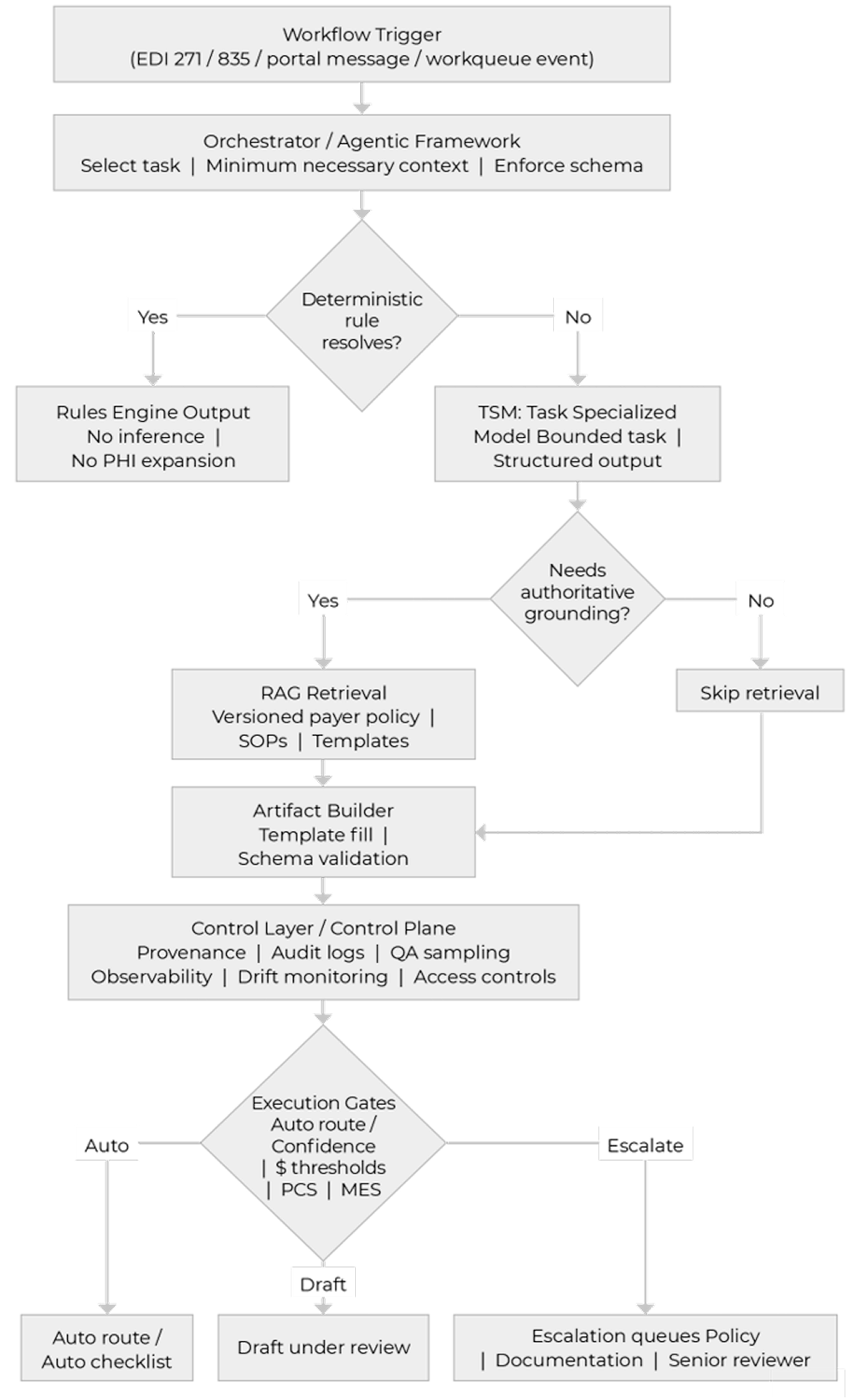
TSM first execution flow: From deterministic rules to governed action | TSM-first execution flow
Here is a workflow to demonstrate how Revenue Cycle work moves through a deterministic-first pipeline, invoking TSMs only when rules cannot resolve the step. A control layer then applies grounding, validation, and execution gates to route each case to policy-bounded system action, draft-under-review, or escalation, with auditability built in.
A working example: Denial intake to appeal draft | Denial intake to appeal draft
A denial arrives through standard remittance channels, typically carrying structured codes plus payer narrative. The first step should be deterministic: extract the fields, attach the record to the right work item, and avoid model inference when extraction can be rules-based.
The TSM enters when interpretation is required. For example, a denial taxonomy classifier can take denial code plus remark text plus minimal claim context and output a bounded label set (category / subcategory), a confidence score, a recommended next action, and a routing target. From there, the control layer determines whether the confidence and risk gates allow auto-routing or require a reviewer.
When the workflow needs payer-policy grounding - especially for evidence requirements - the architecture retrieves the authoritative policy and maps it into a structured checklist. This is where auditability is won: the system is not guessing what the payer wants; it is interpreting retrieved, versioned policy and turning it into required evidence fields.
Finally, drafting should behave like template population under constraints, not free-form prose. A draft-under-review approach allows the system to do the heavy lifting while requiring human review and accountability for external submissions.
Illustration of the gating approach | Gating approach
In production, we treat autonomy as conditional. The control layer applies a small set of explicit gates: it hard-stops and escalates when required evidence is missing, output fails schema validation, policy retrieval lacks a valid / current citation, or confidence falls below the workflow minimum. It also applies dollar-based review thresholds (low-dollar can proceed if other gates pass; mid-dollar demands stricter checks; high-dollar requires human review before external action), and a simple Policy Complexity Score that forces escalation once payer exceptions, multi-document grounding, medical-necessity narratives, or regulatory overlays stack up. Finally, gates vary by workflow: bounded classification can be more autonomous; checklists require stricter completeness; drafting defaults to review at meaningful dollars; and external submission is never fully autonomous at launch.
Where TSM execution delivers measurable lift | Where TSMs deliver lift
Eligibility and authorization
A TSM for eligibility interpretation converts payer language from a 271 response into a structured determination - coverage confirmed, benefit limitation identified, authorization required, demographic mismatch detected, or next action needed. Because outputs are bounded, the control layer can apply confidence gates and route exceptions to human review, reducing preventable downstream touches and improving front-end execution clarity.
Claim edits
A TSM for claim edit explanation interprets the edit, generates precise corrective instructions, flags whether coding or registration review is required, and structures the output for routing. This reduces billing lag and improves clean-claim performance by translating cryptic edits into operationally usable action without relying on free-form interpretation by every individual biller.
Denials and appeals
A TSM for denial taxonomy classification standardizes category and likely root cause, then hands off to policy-grounded checklist generation and constrained drafting under review. Because these outputs are bounded and governable, denial work is especially well suited to task specialization under explicit confidence thresholds, dollar gates, and escalation rules - improving speed and consistency without sacrificing auditability.
A/R prioritization and follow up
A TSM for A/R next step normalization summarizes account state, normalizes inconsistent notes into a standard action status, and suggests the next operational step. When connected to prioritization signals (e.g., days-to-payment or payment ratio), the execution becomes more disciplined and effort can shift toward the most recoverable dollars rather than the loudest queue.
From prediction to execution: connecting prioritization to action | Prediction to execution
Healthcare finance already uses predictive signals - days-to-payment, payment ratio, denial propensity - to inform prioritization. Those signals identify where attention is likely to matter; they do not complete the work. The architectural opportunity is to connect prediction to governed execution: prediction sets priority, while TSMs execute bounded tasks (classification, checklist generation, constrained drafting) under the control layer’s gates.
What healthcare leaders should do next | What leaders should do next
The practical path forward is not a vague enterprise AI initiative. Start with one bounded workflow, one measurable operating problem, and a decision-ready pilot. Choose workflows where outputs are constrained and success criteria are clear - then build the control layer from day one so scaling is earned through measured gates, not asserted.
Measure the program with proof metrics that reflect execution lift: touches per case, time-to-first-action, cycle time, defect rate, and overturn yield. When those improve versus baseline, the downstream financial effects tend to follow as operational consequences, not marketing claims.
How can Vee Healthtek help | How can Vee Healthtek help
We help healthcare leaders operationalize Task Specialized Models (TSMs) as a production execution layer across the revenue cycle - from patient access through denials, A/R, and payment integrity - so models produce artifacts teams can run with, not side outputs that require manual translation.
We bring practitioner depth to define denial taxonomies aligned to real work, queue logic that matches operational routing, and playbooks calibrated to payer behavior. We implement schema-first TSM execution, policy grounding against versioned payer sources, explicit confidence / dollar / complexity gates, and feedback loops where overrides become structured training signal. The combination is what compounds: each interaction improves the system’s execution accuracy and governance posture over time.
Conclusion | Conclusion
The most important strategic shift is not from no AI to AI everywhere. It is from generic AI usage to a governed execution architecture built for the realities of healthcare finance. The more credible path is to place the right kind of intelligence in the right part of the workflow: TSMs for bounded execution tasks, predictive models where prioritization matters, and a control layer that makes outcomes auditable, governable, and enterprise ready.

Battle of the Bots
We joined healthcare finance leaders at the Healthleaders Revenue Cycle Exchange in Sarasota, Florida. The audience? Health System CFOs. Chief Revenue Officers. Senior Vice Presidents of Revenue Cycle. The agenda? Healthcare Revenue Cycle Management (RCM) under pressure - operationally stretched, financially scrutinized, technologically saturated.
If we had to summarize the mood in one phrase:
Cautiously ambitious. Pragmatically innovative.
Not chasing hype. Not resisting change. Building deliberately.
Below are the architectural themes that stood out - and what they mean for modern Healthcare Revenue Cycle Management.
AI is here - but it’s task-optimizing, not headcount-reducing | AI is here
Nine of the thirteen sponsors at the event were AI-first technology firms. If momentum were measurable by conversation volume alone, automation would have dominated the agenda. But inside the roundtables, the tone was different. AI is not replacing revenue cycle teams. It is redistributing effort.
One leader put it memorably:
AI is creating capacity, not reducing headcount
The highest ROI use cases discussed were precise, contained, and measurable:
- Payer policy scraping bots saving ~40 hours per month
- Underpayment recovery teams generating 20:1 ROI
- CDI prioritization engines guiding reviewers to likely documentation gaps
- Predictive analytics identifying denial drivers before submission
The lesson? Blueprint before build.
AI succeeds when applied to repeatable tasks with clear ownership and measurable outcomes. End-to-end “revenue cycle transformation by switch activation” remains fiction.
Denials are rising - the real work is upstream | Denials are rising
Denial rates across systems hovered between 10–15%, with struggling organizations pushing toward 20% and above. The most concerning trend? Clinical denials. Documentation gaps. Medical necessity. Missing elements that originate not in the billing office - but in the clinical encounter.
One executive distilled it sharply:
We don’t have a denial problem. We have a documentation discipline problem.
The shift underway is from reactive appeals to predictive prevention:
- Root cause identification by payer, procedure, and diagnosis
- Accountability for denial drivers within operational teams
- CDI embedded earlier in workflow
- AI surfacing likely denial triggers before submission
This is not about writing better appeal letters. It is about engineering fewer denials into existence. Prevention is cheaper than persuasion.
Enterprise EHR platforms are the foundation, but not the entire structure | EHR foundation
Every large system represented operates an EHR Platform. Yet a striking theme emerged: Turning functionality “on” is easy. Operationalizing it is hard.
Leaders were candid:
- EHR automation still requires human oversight
- Enablement demands IT staffing, training, certifications, and ongoing investment
- Some AI capabilities within EHR remain maturing
The strategic debate wasn’t one platform versus another. It was this: “What is the true 20-year cost of internal enablement versus outcome-based partnerships?”
Modern Revenue Cycle is not a single-platform play. It is orchestration - specialized tools across front, middle and back office. One system of record, multiple systems of optimization.
Vendor expectations have changed - permanently | Vendor expectations
If there was one unmistakable shift over the past decade, it is this: Health systems will not subsidize vendor learning curves.
A CFO said it plainly:
We can’t pay you to figure us out.
Expectations now include:
- Conservative ROI modeling
- Shared accountability
- Performance-based contracts
- Defined SLAs tied to denial reduction, A/R improvement, productivity
- Real-time operational visibility
Partnership is no longer a slogan. It is a risk-sharing structure. Trust is not earned by capability decks. It is earned by measurable outcomes.
Workforce reality - automation changes roles, not necessarily headcount | Workforce reality
There was a contrarian tension throughout the event: AI investment is accelerating. Labor shortages persist. Why? Because most health systems are not overstaffed. They are understaffed.
The focus is shifting toward:
- Repurposing talent
- Upskilling adaptable performers
- Identifying “diamonds in the rough”
- Paying for skill without forcing management promotion
One rural CFO captured it perfectly:
I don’t have people. I have a person
Small and rural hospitals face amplified constraints - limited staff, older platforms, cultural barriers to collections. For them, automation is less about transformation and more about tool augmentation. Technology must reduce friction, not remove humanity.
Evolution beats revolution | Evolution beats revolution
One misconception quietly dissolved during the discussions: Massive platform change is not the primary differentiator of high-performing systems.
The leaders are winning through:
- Workflow restructuring
- Operational accountability
- Real-time performance visibility
- Process discipline
More evolutionary than revolutionary. More engineering than theater. Modern Healthcare Revenue Cycle Management is less about buying something new - and more about architecting what already exists into a cohesive system.
The quote that stayed with us
One session described the emerging landscape as: “The battle of the bots.” Hospitals deploy bots to submit cleaner claims. Payers deploy bots to review, delay, or deny. Automation versus automation.
Which means the future of Revenue Cycle is not simply digitized workflows - it is strategic counter-automation. The systems that will thrive are not those with the most bots.
They are the ones with:
- Clear use-case discipline
- Structured ownership
- Transparent ROI
- Operational readiness
Automation without architecture becomes noise.
What CFOs and Revenue Cycle leaders should prioritize now | CFO priorities
From dozens of conversations, three leadership imperatives emerged:
- Build a Task-Based Automation Roadmap. Not a technology roadmap. Define the task, quantify the pain, then deploy precision tools
- Engineer Denial Prevention Upstream. CDI, documentation feedback loops, predictive analytics - prevention is margin protection.
- Demand Measurable Partnership. Outcome-based contracts. Transparent SLAs. Shared accountability.
Revenue cycle is no longer a back-office function. It is financial infrastructure.
Final reflection - resilient systems win | Final reflection
The real takeaway from the event was strategic clarity. Healthcare Revenue Cycle Management is entering a phase of disciplined modernization: Innovative, but pragmatic. Ambitious, but accountable. Technology-led, but human-aware.
And that, more than any bot, will determine who wins the next chapter of revenue cycle.
Have a Question for Vee Healthtek?
Vee Healthtek is a practitioner-led, technology-powered revenue cycle partner focused on building resilience through first-pass performance and open accountability. For service inquiries, company information, or questions about our latest announcements, complete the form below. We’ll direct your interest to the right team.
Continue exploring expert perspectives, industry trends, and practical strategies for improving revenue cycle performance.
Explore Points Of View