

Clinical documentation gives coders the detail payers want
What specificity in the note does to the final claim
November 23, 2026
Blog
6 minutes

TL;DR
- Coders assign only what the physician's note supports, so vague notes lower payment before billing starts.
- Late queries and payer denials turn thin notes into rework and slower cash.
- Prompts inside the record and a named owner for each target fix notes at the source.
A coder can only bill what the physician wrote | What Coders Can Bill
Clinical documentation sets the ceiling on what a hospital can bill before any claim exists. Coders work only from what the physician wrote, so a vague note lowers payment before billing starts. A coder can't infer a diagnosis from lab values or assign severity from a treatment pattern. Every gap in the note becomes a gap in the claim.
The attending physician owns the note. Clinical documentation integrity (CDI) specialists and medical coders read it, but only the physician changes what it says. This split turns physician habits into a revenue integrity issue long before finance sees a variance.
Coders look for four details in each diagnosis: the condition, its type or cause, its severity, and its body site or side. A note with all four lets the coder assign a precise code. A note missing one pushes the coder toward an unspecified code or a physician query. Leaving this to the back end costs a hospital twice: first in the lower code, then in the query and rework that follow.
One word in the note moves the claim into a different payment tier | How One Word Moves Payment
Specificity coding means assigning the most precise code the note supports. That specificity can affect the diagnosis related group (DRG) and inpatient payment when it changes the coded record under applicable grouping rules. Heart failure written without type or acuity may code to an unspecified diagnosis. Documenting acute on chronic systolic heart failure supports a more specific code and may affect DRG assignment when the complete record and grouping rules support it. Severe malnutrition follows the same principle, but the note must carry the clinical indicators, not just the label.
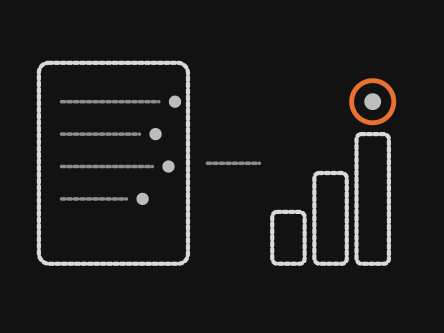
Picture two patients admitted with the same condition and treated the same way. One physician names the type and acuity. The other writes the diagnosis label alone. The hospital submits two DRGs and collects two payments for equivalent care. Finance sees a payment variance, but the cause lives in the note. Four questions explain the gap.
The note-to-cash test
A query after discharge delays cash and returns a thinner answer | Why Late Queries Cost Cash
A physician who gets a query days after discharge has to reconstruct the case from memory. The answer takes longer to arrive and carries less clinical detail. Meanwhile the claim stays unbilled.
The rework doesn't stop at the query. In its 2025 industry survey, the Association of Clinical Documentation Integrity Specialists found 87.73% of CDI programs review clinical validation denials, up from 85.54% in 2024. Reviews of DRG validation denials climbed from 54.66% of programs to 64.11% over the same period, as the chart below shows. Each review is rework the original note could have prevented.
Payers audit the record for clinical support, not the coder's reasoning. The American Hospital Association reports care denials rose 20.2% for commercial claims and 55.7% for Medicare Advantage claims between 2022 and 2023. A code the note can't defend turns into an appeal, a records request, or a payment takeback. Each one adds cost to collect on revenue the hospital already earned.
The cheapest fix happens while the physician is still writing | Fixing Notes at the Source
A clinical documentation program works when the prompt reaches the physician while the note is still open. A note that's right at signature needs no query and no appeal, which is how first-pass performance gets built. Everything after signature is rework.
Templates and smart phrases in the electronic health record (EHR) prompt for type and acuity, which lifts specificity quickly. They backfire when they pre-fill normal findings or copy old text forward, because auditors read cloned notes as weak evidence. Teams that pair templates with physician education built from their own denial patterns see gains in physician compliance and cash flow.
Artificial intelligence (AI) tools scan notes for missing specificity and prompt the physician before signature. A 2025 Bain & Co. survey, reported by the Healthcare Financial Management Association, found 43% of providers directing AI investment to clinical documentation improvement and payer compliance assurance. AI-assisted documentation surfaces the gap, and a clinician supplies the judgment.
Technology still needs an owner. In the CDI survey, 71.22% of respondents indicated the use of a physician advisor, the highest share since the survey began asking routinely. Naming one owner for each target, such as query response or specificity rate, gives finance a number to track each month. Three measures make a practical start: query response time, the share of diagnoses documented with type and acuity, and the clinical validation denial rate by service line. A rising denial rate beside a flat specificity rate points to a physician habit rather than a coding error. This is open accountability in practice: every gap traces to a person, a measure, and a date.

Talk to an expert about your documentation gaps
Fill in the form to share where coders stall on physician notes. An expert will trace each gap to a fix at the source.
Continue exploring expert perspectives, industry trends, and practical strategies for improving revenue cycle performance.
Explore Points Of ViewFrequently Asked Questions
What is clinical documentation in healthcare?

Why can't coders fix a vague note after discharge?
What is specificity coding, and why does it change payment?
What are examples of clinical documentation improvement?
What does a clinical documentation program include?
Do templates and smart phrases improve clinical documentation?